For most Liebherr refrigerators, a failed Liebherr electronics board is worth repairing when the cabinet is otherwise sound, and worth replacing only when the board is the last of several aging parts or the sealed system is also failing. The board is a replaceable module, not part of the cooling circuit, so a dead display, a communication error or a cabinet that will not respond does not automatically mean the end of the refrigerator. What decides it is a diagnosis that separates the board from the sensors, the wiring and the power it receives.
What does the electronics board do in a Liebherr refrigerator?
Inside the cabinet, a small set of modules replaces the old mechanical thermostat. The main control board reads the temperature sensors and decides when the compressor, the fans and the defrost heaters run. The display module is how you talk to it, and on connected models the SmartDeviceBox carries the data to your phone. These modules exchange messages continuously. When one stops answering, the cabinet may keep cooling on its own program, show a code or refuse to accept settings.
Because the modules are separate parts, a fault in one rarely requires replacing the rest. A failed display can leave the cooling running perfectly, and a failed SmartDeviceBox can leave the display untouched. That modular design is the first reason repair is often sensible: you replace one module, not the cabinet.
Which symptoms point at the board, and which do not?
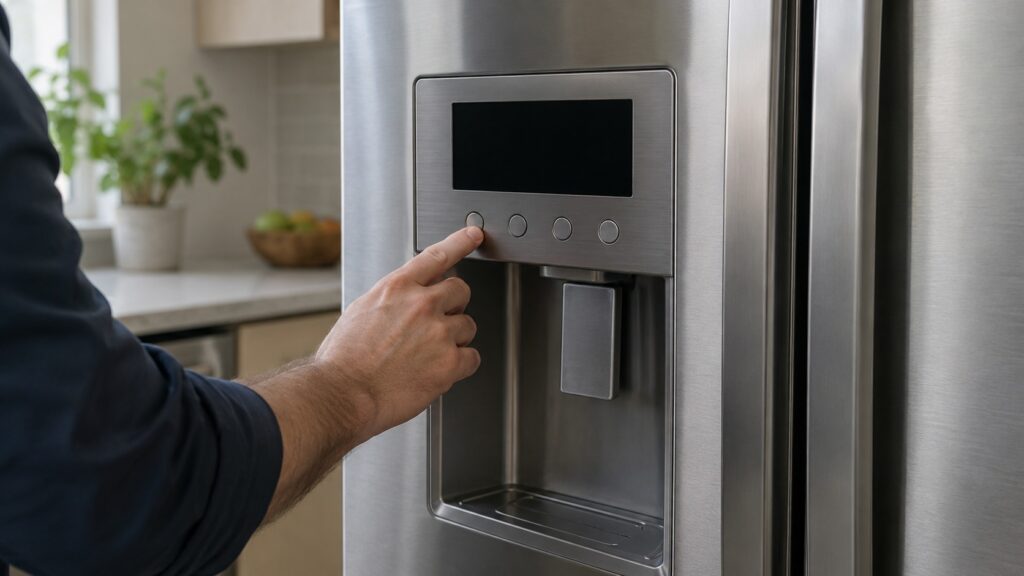
Symptoms that suggest the board or display include a completely dark panel with the fan and compressor still running, buttons that do not respond, a temperature that jumps or freezes on the screen, alarms that sound for no reason, and communication codes. Our guide to PH001 and PH002 communication errors explains the codes in detail, and the display symbols guide covers what the panel can show.
Symptoms that look like a board problem and are not include a sensor code, which points at a cheap temperature probe, and a cabinet that is simply warm because a fan or the sealed system has failed. Our guides to the F1 to F4 sensor codes and the BT sensor codes show how a sensor fault announces itself. Diagnosing the sensor first saves the cost of a board that was never at fault.
What should be checked before anyone blames the board?
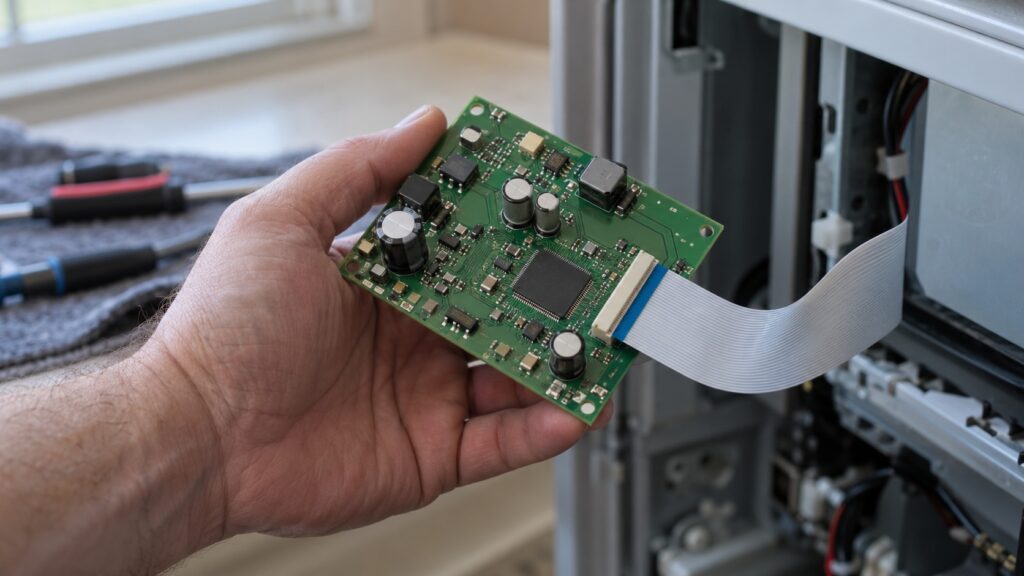
A technician should work through the cheaper causes in this order. First, the power: a loose plug, a weak outlet or a surge can leave a board in a confused state, and a five minute power cycle at the breaker clears many of them. Second, the connectors and the harness, because a ribbon cable that has worked loose or corroded in a damp room produces exactly the same symptoms as a failed board. Third, the sensors, which are inexpensive and fail often. Fourth, the board itself, tested for output and for signs of damage such as burned traces or swollen capacitors.
Do this in order because the cheapest cause is also the most common. A board is the most expensive item on the list, and replacing it without testing the others means paying for a part that was perfectly good.
When is repairing the board the right call?
Repair makes sense when the diagnosis points at one module, the cabinet is relatively young and the rest of it is in good shape. A refrigerator with a clean interior, tight door seals, a quiet compressor and a single failed display is a cabinet worth keeping. Liebherr cabinets are built to last a long time, and the cost of a module is usually a small fraction of a new unit with the same features. A technician visit also gives you a firm diagnosis rather than a guess, so you decide with facts. Our general repair or replace guide for Liebherr fridges sets out the broader checklist.
It makes even more sense on built-in and column models where replacement means cabinetry work. For those, our repair or replace guide for Monolith columns adds the installation costs that tip the balance toward repair.
When does replacement make more sense?
Replacement wins when the board is one of several problems. If the compressor is weak, the door seals are failing and the cabinet is old, a new board fixes only one of three things. It also wins when corrosion has reached the board because of a leak, since moisture damage usually spreads to the connectors and the harness. And it wins when the cabinet is old enough that the next failure is likely within a year or two. The decision is rarely about one part, so ask the technician what else they saw while the panel was off.
When you compare, think in terms of total ownership. A part swap is usually far cheaper than a new unit, but if you will face another repair next year, the arithmetic changes. Ask for the diagnosis in writing and consider a visit from our refrigerator repair service before you commit to a new cabinet.
Is a board repair safe to do yourself?
No. The board carries mains voltage, and capacitors on it can hold a charge after the power is off. Disconnecting plugs and swapping modules also risks bending pins and creating new faults. What you can safely do is power cycle the cabinet, check that the plug is seated and photograph the code and the display before you call. Leave anything that involves opening the electronics housing to a technician.