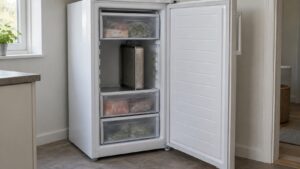
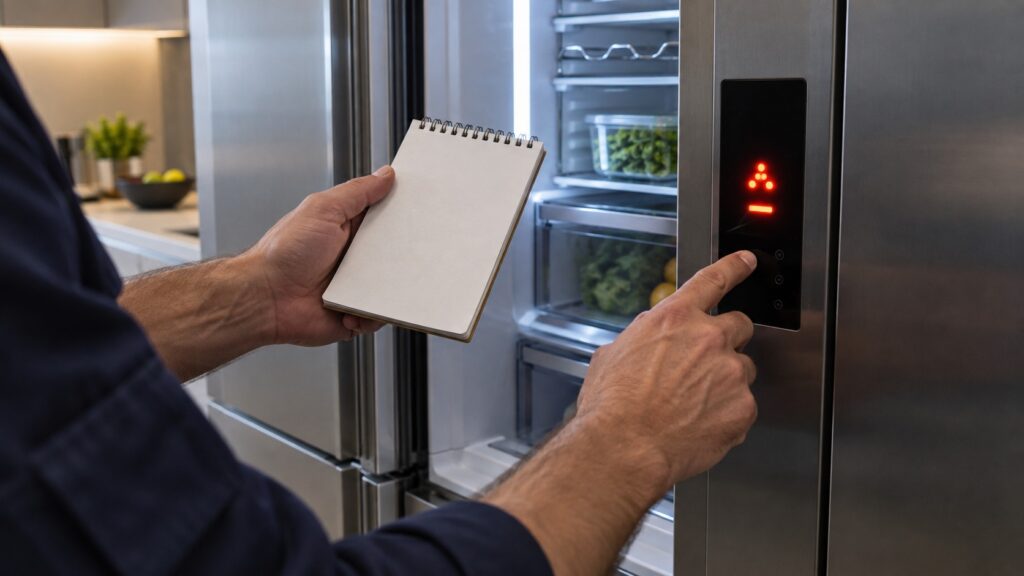
Liebherr F1 F2 F3 F4 sensor codes are all sensor-failure codes reused across the product line, and which sensor each number points at depends entirely on which appliance is showing it. On a Monolith column, F1 means the refrigerator-compartment sensor has failed and F2 means the evaporator sensor has failed. On a freezer, F3 means the freezer air sensor has failed and F4 means the freezer evaporator sensor has failed. On a wine fridge or wine cabinet, F1 means a temperature sensor failure in that unit specifically. The pattern across all of them is the same — a temperature sensor has stopped reporting reliably — but the physical part and its location differ by appliance, so looking up “F1” without first identifying the appliance can send you to the wrong fix entirely.
Why does Liebherr reuse F1 through F4 across so many appliances?
Liebherr’s service electronics assign fault numbers by function rather than by a single universal part list, and “sensor reporting a bad or missing signal” is a function nearly every refrigeration appliance in the lineup has, because nearly every appliance needs to know its own internal temperature to run its compressor and defrost cycle correctly. Because a Monolith column, a freezer, and a wine cabinet all rely on this same basic function, the low F-numbers get reused across all of them. The appliance itself, not the number, decides which physical sensor is actually implicated.
This is the same pattern documented across Liebherr’s other reused code families — the number describes the type of problem, and the appliance you are looking at supplies the rest of the address.
How do you tell which sensor is actually at fault?
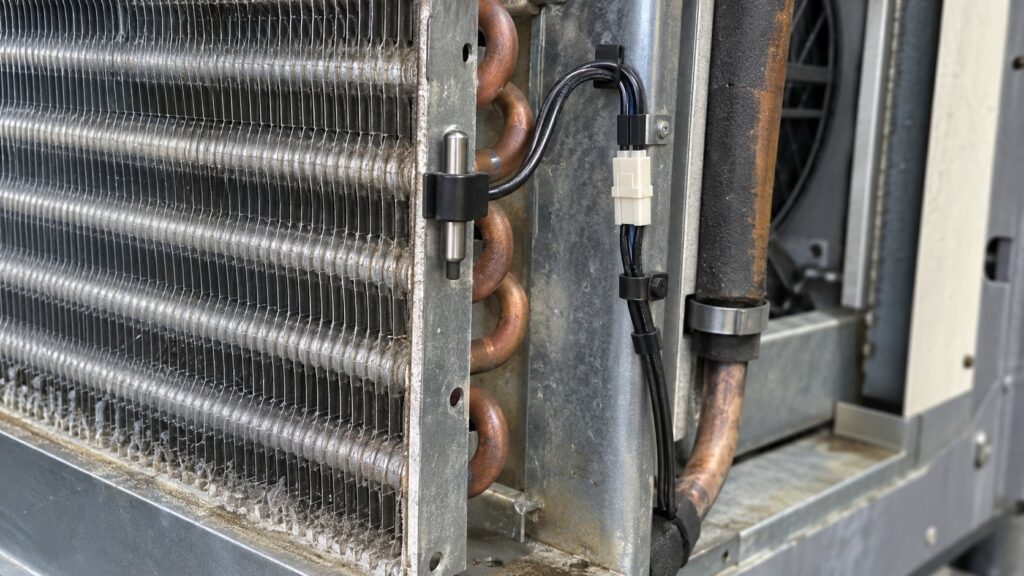
Start by confirming the appliance, not the number. A Monolith column showing F1 points at the refrigerator-side sensor, typically mounted near the main cooling compartment; the same column showing F2 points at the evaporator sensor instead, mounted near the cooling coil behind an interior panel. A freezer showing F3 points at the air sensor that reads the general compartment temperature, while F4 on the same freezer points at the evaporator sensor specifically. These are different physical parts in different locations, and ordering the wrong one from a mislabeled code is a common, avoidable delay.
On a wine fridge or wine cabinet, F1 is simpler in one sense — there is generally only one primary temperature sensor per zone to consider — but a dual-zone unit can still show which zone is affected depending on where in the display the code appears, so note the zone along with the code itself.
It also helps to know what these codes are not. None of the F1 through F4 codes describe a door left open, a power outage, or a demo-mode setting left on by mistake — those show up as separate alarms on the display, covered in our fridge display symbols guide. If the display is showing an icon rather than a letter-number code, you are likely looking at a different kind of alert entirely, and treating it as a sensor fault will send you down the wrong troubleshooting path.
What can you check yourself before calling for service?
- Cut power for two minutes and restart. An intermittent sensor connection sometimes clears on its own after a power cycle, though a code that returns immediately is reporting a live fault rather than a one-time glitch.
- Note the exact appliance and code together — “F1 on the Monolith” and “F1 on the wine fridge” are two different faults, and writing down both matters more than the number alone.
- Check whether the appliance is still cooling at all. A sensor fault sometimes leaves the compressor running on a fallback cycle, which buys you time before food or wine is at risk, while a complete stop is more urgent.
- Avoid opening the sealed cabinet or evaporator compartment yourself. The evaporator sensors in particular sit close to the cooling coil, and reaching them without the right access panel removed risks damaging parts that were not at fault.
Are these sensor faults urgent?
A refrigerator or freezer air sensor fault (F1 on a Monolith, F3 on a freezer) is worth prompt attention because it can affect how accurately the appliance holds food-safe temperatures, even if the compressor is still running. An evaporator sensor fault (F2 on a Monolith, F4 on a freezer) is a bit more variable — some units keep cooling reasonably well on a fallback routine while others show wider temperature swings, so it is worth checking actual temperature with a separate thermometer rather than assuming the worst from the code alone. On a wine cabinet holding an aging collection, treat any F1 code as more urgent than the same code would be on a short-term serving fridge, since a temperature swing has more time to affect wine that will sit for years.
It is also worth watching whether a sensor code returns after a power cycle or stays cleared. A code that clears and does not come back for weeks may have been triggered by a brief electrical disturbance rather than a failing sensor, while a code that returns within hours or days points at a genuine hardware fault that a reset will not fix permanently. Keeping a rough log of when a code appears and reappears gives a technician useful context beyond the code itself.
Does the fault affect the whole appliance or just the reading?
A sensor failure means the control board has lost a reliable reading, not necessarily that the compressor, the door lock, or the rest of the cooling system has failed alongside it. On many Liebherr appliances, a control board that loses a sensor’s signal falls back to a default cycle designed to keep cooling roughly on target until the sensor is replaced, rather than shutting the whole unit down. That fallback behavior is a safety measure, not a full fix — it buys time, but it is not a substitute for replacing the failed sensor, since a fallback cycle is deliberately conservative and not tuned to the specific conditions inside your kitchen or cellar.
What should you do next?
Write down the appliance type, the exact code, and whether the unit is still cooling before you contact anyone — that combination is what lets a technician bring the correct sensor part on the first visit rather than a second trip. For a broader look at codes on a specific appliance, see our refrigerator error codes guide, our freezer error codes guide, or our wine cooler error codes guide. If the code is on a Monolith column specifically, our Monolith error codes guide covers that lineup’s other common faults. You can schedule a visit and provide the appliance and code so the right sensor is on hand for the first appointment.