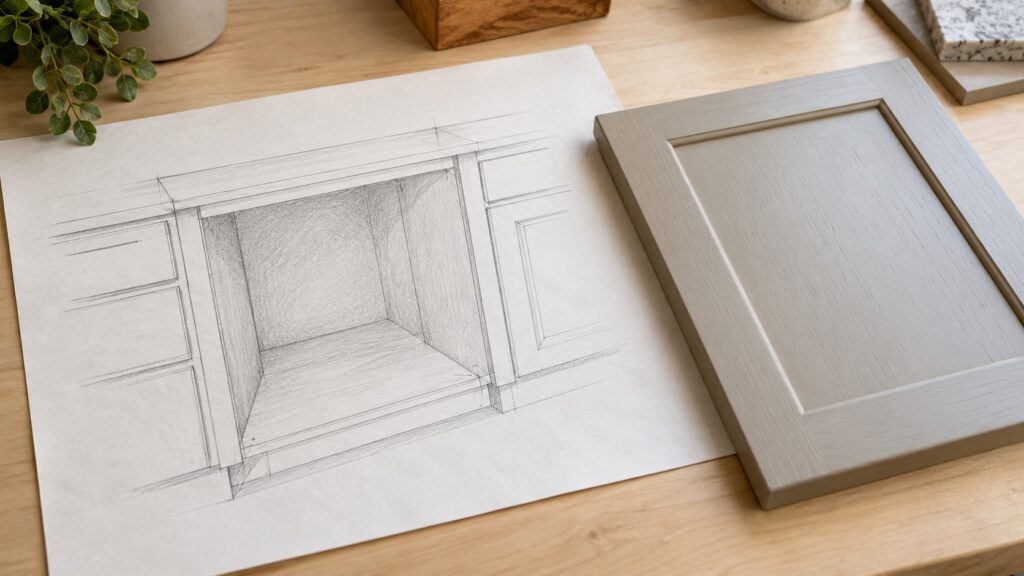
The Liebherr niche width and height meaning is simple once the words are clear: the niche is the opening in your cabinetry that a built-in refrigerator slides into, and its width, height and depth come from the installation sheet for your exact model, not from a catalog or a neighbor’s kitchen. This glossary explains the words on a Liebherr built-in sheet and in a kitchen designer’s drawings: niche, plinth, ventilation path, furniture door, panel-ready, fixed hinge, sliding hinge and a few more. It defines terms. It does not give dimensions or fitting steps, because those differ by model.
What is a niche, and what do its width, height and depth mean?
A niche is the finished opening in the cabinets where a built-in refrigerator or freezer stands. Its width is measured side to side between the cabinet panels, its height from the floor up to the underside of whatever sits above, and its depth from the wall to the front edge of the cabinets. A niche that is too small will not take the unit. One that is too large leaves gaps that let the furniture door look uneven and make fixing harder. The numbers to build to are printed on the installation sheet for your exact model number, and our Liebherr model number decoder helps you read the code so you pick the right sheet.
Our integrated models page lists units such as the IRBd 5151, IRBd 4150, ICNe 5103 and ICBNd 5163, and our guide on integrated refrigerator installation says they come in several heights and widths that are not interchangeable. Our Monolith pages describe full-height columns 24, 30 and 36 inches wide. Always confirm niche height and depth on the sheet.
What are the plinth and the ventilation path?
The plinth is the strip at the foot of the cabinetry, sometimes called the toe kick. In a built-in installation it is often where cool air comes in. The ventilation path is the route air takes through the niche: in at one point, past the part of the unit that sheds heat, and out at another, usually at the top. Your installation sheet states how much free opening each end needs. A built-in unit cannot shed heat through its back the way a freestanding one can, so a blocked path is a frequent reason for a built-in to run warm or run all day.
In practice this means do not fill the gap behind the appliance with insulation or cable ties, and do not shrink the opening to suit a decorative plinth. If you use a plinth panel, leave the ventilation slot open behind it. Our freezer installation and clearances guide describes the same idea for other units.
What is a furniture door, and what does panel-ready mean?
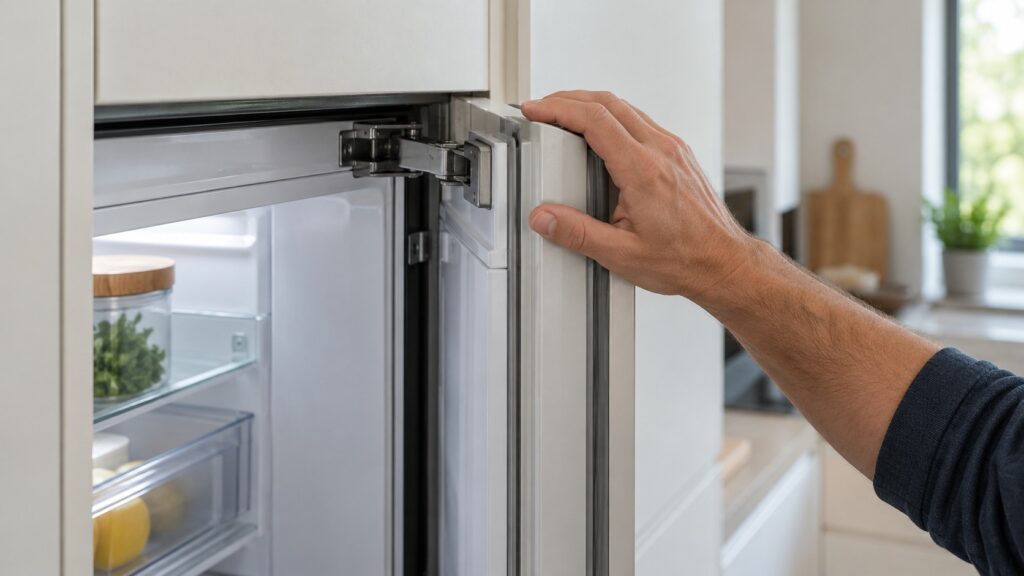
An integrated refrigerator carries a furniture door that matches your cabinets. It is a separate panel joined to the appliance’s own door with brackets that come with the unit. Panel-ready is the term for a unit made to take such a custom panel; our Monolith model pages list the finish as panel-ready for custom cabinetry or stainless. If you would rather see a finished metal front, our guide on SteelFinish vs BlackSteel compares the two stainless finishes.
The bracket template is the paper sheet that comes with the appliance and shows where the brackets go. Depending on the model, the brackets may allow some adjustment of the furniture door’s position. The exact adjustment points differ by model, so follow the sheet.
What is the difference between a fixed hinge and a sliding hinge?
Integrated doors do not all move the same way. Our integrated installation page says some models use a fixed hinge and others use a sliding arrangement that lets the furniture door glide forward as it opens. Our integrated installation page says the hinge system differs between models, so the term on your sheet tells you which you have. Door swing and hinge side are separate: the hinge side is which edge the door is hinged on, and many freestanding models allow it to be reversed, as our guide on reversing a Liebherr fridge door explains.
SoftSystem is a different thing again. On Monolith columns it is the soft-close hinge and damper that eases a door shut, not the door seal. Our SoftSystem hinge care guide covers it.
What do anti-tip, level and clearance mean?
Anti-tip refers to the fixing hardware that anchors a tall column to the cabinetry so it cannot fall forward. Level means the unit sits flat in both directions so its door closes on its own and the seal grips evenly. Clearance is the free space the sheet asks for around the unit so doors and drawers open and air can move. None of the three is optional, and all three are set out in the installation sheet. Because they involve anchoring a heavy unit, cabinetry and ventilation, a built-in is normally fitted by an installer or cabinetmaker.
If your refrigerator was installed recently and runs warm, a niche problem is more likely than a part failure. A diagnostic visit can tell the two apart; our Liebherr refrigerator repair page explains how it works, and you can schedule a visit online. We are an independent repair company, not the manufacturer.