
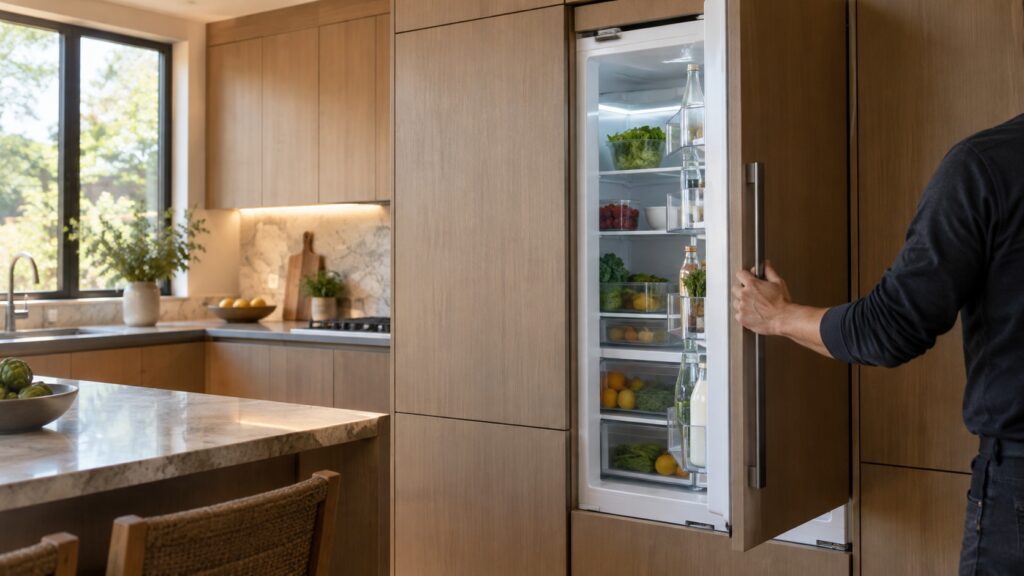
Liebherr integrated refrigerator installation starts with the cabinet niche, not with the appliance: the niche must be the right size, square and level, it must leave a ventilation path, and the furniture door must be mounted to the appliance with the hardware supplied for your model. Done in that order, an integrated refrigerator closes smoothly and cools efficiently, while a rushed fit shows up later as a door that drags, a gap along the edge or a unit that runs constantly.
What should the niche look like before the refrigerator arrives?
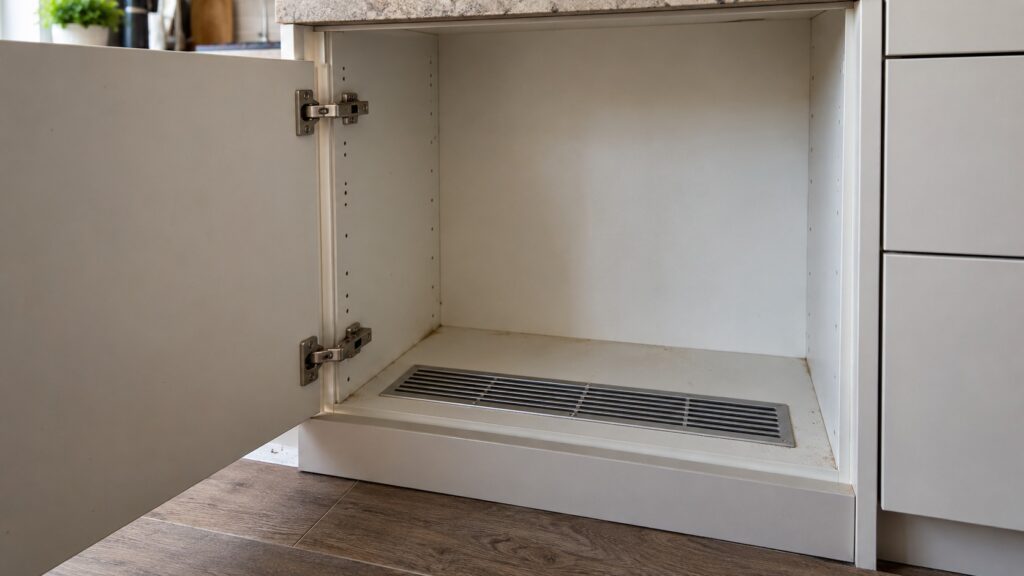
An integrated Liebherr refrigerator slides into a cabinet niche, so the niche is part of the appliance. Take the dimensions from the installation sheet for your exact model number rather than from a catalog, because the integrated range includes several heights and widths and they are not interchangeable. The niche should be square, with solid side panels and a back wall that does not interfere with the ventilation path. Check the floor with a level in both directions, and fix any slope before the appliance goes in, since an adjustable foot can correct small differences but not a sagging cabinet base.
Our models page lists the integrated units as the IRBd 5151, IRBd 4150, ICNe 5103 and ICBNd 5163. The letters tell you the appliance type, and the numbers tell you roughly its height class, but you should always confirm the niche height and depth on the sheet. Our model number decoder helps you read the code.
How much ventilation does an integrated refrigerator need?
A refrigerator rejects heat through its condenser, and an integrated one hides that condenser behind panels. The installation sheet specifies a cross-section of free air at the plinth and at the top of the niche. Do not shrink either opening, and do not fill the gap behind the appliance with insulation or cable ties. A niche that traps heat makes the compressor run longer, raises the energy use and shortens the life of the unit. If your design includes a decorative plinth, leave the ventilation slot open behind it.
Our freezer installation and clearances guide describes the same principle for other built-in units. The numbers differ, but the reasoning is the same.
How is the furniture door attached and adjusted?
Integrated refrigerators carry a furniture door that matches your cabinets. The appliance door and the furniture door are joined by brackets that come with the unit, and the hinge system differs between models: some use a fixed hinge and others use a sliding arrangement that lets the furniture door glide forward as it opens. Follow the paper template that comes with the appliance to mark the bracket positions, and fit the furniture door only after the refrigerator is level and fixed.
Adjust the door in small steps. Most systems let you move the furniture door up and down, in and out and from side to side with screws on the brackets. A door that sits too high will catch on the cabinet above it, and a door that sits too low will leave an uneven gap. A door that drags usually has a bracket that has loosened or a hinge that was not square. A common search is how to adjust the cupboard door on an integrated Liebherr fridge, and the answer is always to loosen the bracket screws a quarter turn, move the door a hair’s width, and tighten them again. If you want the door to open the other way, our guide to reversing a Liebherr fridge door explains the process for models that allow it.
What about power, water and connectivity?
An integrated refrigerator needs a grounded outlet that you can reach without moving the unit. Place the outlet beside or above the niche, not directly behind the appliance where the plug presses against the back wall and keeps the unit away from the cabinet. If the model has a water connection for an ice feature, run the line and the shutoff valve before the refrigerator goes in. If the model supports connectivity, set up the Wi-Fi link after the unit has stabilized, as described in our SmartDevice Wi-Fi setup guide.
What should you check after the refrigerator is in?
- The unit is level and does not rock when you press on a corner.
- The door closes by itself from a few inches and seals along its full edge.
- The furniture door lines up with its neighbors and does not touch them.
- Ventilation openings are clear.
- The temperature display settles after a day without alarms.
Do not fill the unit until it has been running for the time the manual states. If an alarm appears at start-up, check the door first, because a door that is held open by the furniture panel is the most common cause. If you decide to compare a built-in with a freestanding unit before you commit, the integrated vs freestanding fridge guide weighs the options.
When is it worth getting help?
Installation by a cabinetmaker or installer is common for integrated units because the cabinet and the appliance have to agree. If the refrigerator does not cool after a day, makes a constant noise or shows an alarm that does not clear, a diagnostic visit can separate an installation problem from a fault. Our refrigerator repair page describes what happens during a visit.