
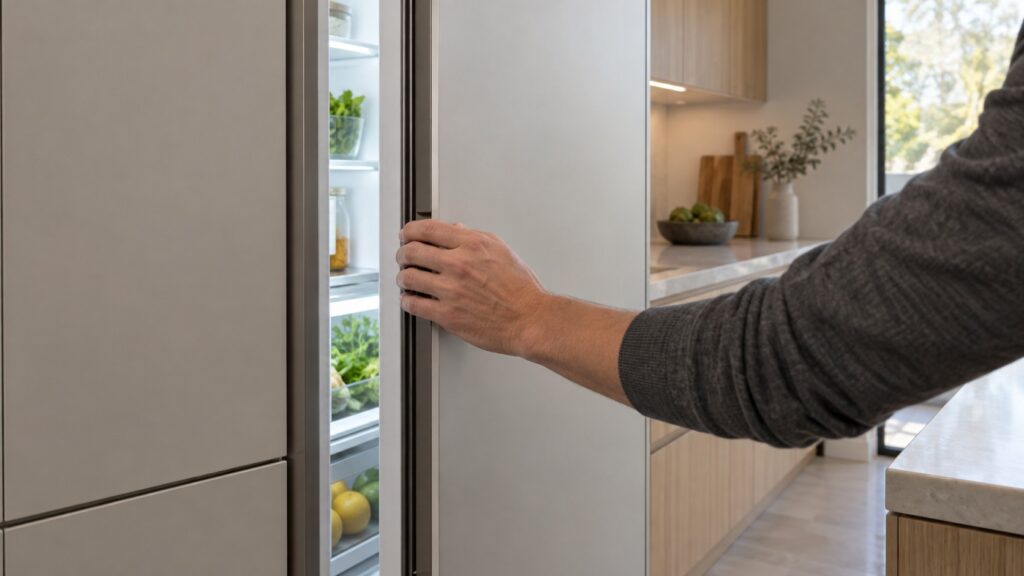
Caring for a Liebherr Monolith SoftSystem hinge means keeping the soft-close mechanism itself working smoothly, which is a different job from replacing a worn door seal. SoftSystem is the integrated hinge-and-damper assembly that catches a Monolith door in the last few inches of travel and eases it shut, even on a fully loaded refrigerator door that would otherwise slam under its own weight. Over years of daily opening and closing, the mechanism can pick up dust and grease from the kitchen air, or its damping action can weaken, and neither problem is fixed by the same steps that fix a leaking or brittle door gasket. Because the two mechanisms sit close together on the same door — the hinge and damper at the edge, the gasket running around the whole frame — it is easy to blame the wrong one when something feels off, which is exactly why this guide keeps the two separate throughout.
What does normal SoftSystem wear look like versus a fault?
A healthy SoftSystem hinge closes the door with a smooth, even deceleration — you can push the door with normal force and it eases the rest of the way on its own without your hand doing the final work. Normal wear over years shows up as a very gradual softening of that action, not a sudden change. If the door starts slamming the last inch instead of easing, or if it closes unevenly with a slight jerk partway through, that is worth attention rather than something to write off as “just getting old” — mechanisms that fail this way are wearing at a specific point rather than aging uniformly.
What is not a SoftSystem fault: a door that will not close flush at all, one that bounces back open, or one with a visible gap at the seal. Those symptoms point at the door gasket or the door’s alignment on its hinges, not at the soft-close damper — our door seal replacement guide covers that separate issue.
How should you clean around the SoftSystem hinge?
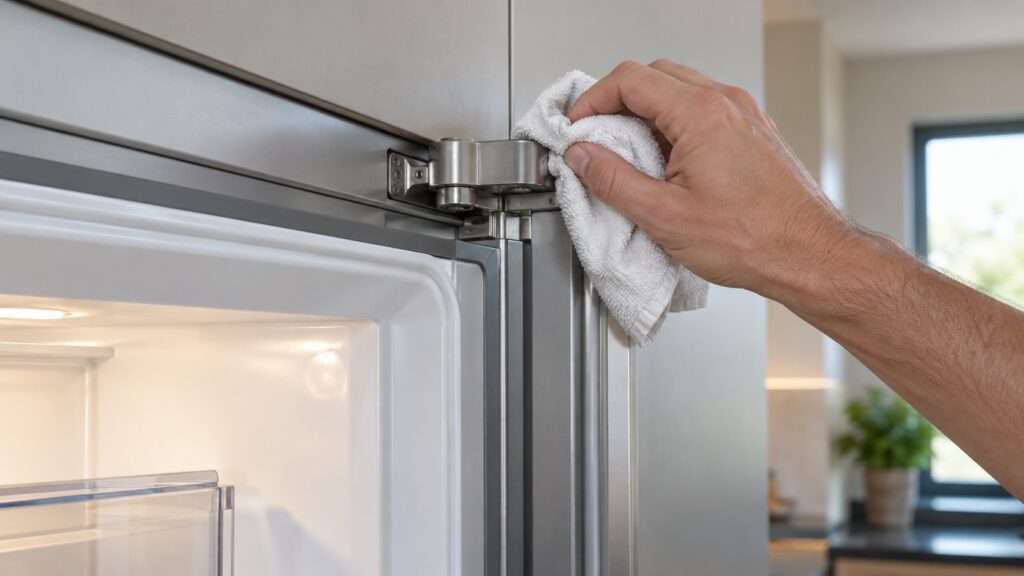
The visible hinge housing at the top and bottom of a Monolith door can be wiped with a soft, slightly damp cloth every few months, more often in a kitchen where cooking grease reaches the appliance area. Focus on the outside of the housing rather than trying to get cleaner into the mechanism itself — the damper inside is a sealed unit, and pushing moisture or cleaning spray into it does more harm than the dust it might remove. A dry microfiber cloth run along the visible hinge arm after your regular kitchen cleaning is usually enough to keep grease from building up where it can eventually stiffen the door’s swing.
Never spray household lubricant, cooking oil, or general-purpose oil into the hinge or damper. These sealed mechanisms are not designed to be lubricated by the homeowner, and oil sprayed into a sealed damper tends to attract dust rather than smooth the mechanism — it can make a stiff hinge worse within months rather than better.
Who should attempt an adjustment or repair to the mechanism?
SoftSystem is a sealed hinge-and-damper assembly, not a component designed for a homeowner to open up and adjust internally. Where a genuine adjustment is possible — some designs allow a limited external tension adjustment without opening the sealed housing — this is best handled by a technician familiar with the specific Monolith model, since an incorrect adjustment can leave the door closing too fast in one direction and too slow in another rather than actually fixing the original complaint. Attempting to disassemble the housing itself to inspect or lubricate the internal damper voids any expectation of a clean repair, since these units are not designed to be reassembled reliably outside a service setting.
Does door weight or loading affect SoftSystem over time?
Yes, within normal limits. SoftSystem is engineered to handle a fully loaded Monolith door, including the weight of shelves, bins, and stored food or bottles pressed against the door’s own storage racks, and using the door normally with a full load will not damage the mechanism. What does add unnecessary strain is forcing the door shut faster than the damper is easing it, which happens when someone pushes the door hard instead of letting SoftSystem take over in the last few inches. Over years, habitually forcing the door can accelerate wear on the damper’s internal mechanism, even though the system is built to resist normal daily use.
What should you check if the door feels stiff or uneven?
- Check the door is still level — a Monolith column that has shifted slightly on its leveling feet can make a fine hinge feel stiff even when the mechanism itself is healthy.
- Clean the visible hinge housing with a dry or barely damp cloth, without spraying anything into it.
- Test both directions — open the door partway and let go, then push it fully closed by hand, to see whether the unevenness happens on opening, closing, or both.
- Note whether the issue is new or gradual — a sudden change after moving the appliance or adjusting cabinetry points at leveling; a slow change over months points at the mechanism itself.
How does SoftSystem relate to SuperQuiet?
SoftSystem and SuperQuiet are often mentioned together because they sit on the same Monolith columns and both target a quieter kitchen, but they solve different problems. SoftSystem controls how the door itself moves and closes; SuperQuiet is Liebherr’s low-noise engineering for the compressor and internal fans, unrelated to the door mechanically. A column can have a perfectly smooth SoftSystem hinge and still run a noticeably loud compressor if a fan bearing is wearing out, and conversely a door can start closing roughly while the compressor runs completely silently. If you are trying to track down an unfamiliar noise, deciding whether it happens when the door moves or continuously while the appliance is idle is the fastest way to tell which system is involved before calling for service.
If cleaning and a level check do not resolve stiff or uneven closing, the damper mechanism itself may need adjustment or replacement, which is not a homeowner-serviceable repair on a sealed SoftSystem unit. Our SoftSystem and SuperQuiet explained guide covers how the mechanism works in more depth, and our guide to Monolith column configurations is useful background if you are comparing units before a repair-or-replace decision. For a hands-on inspection, you can schedule Monolith repair service or book a visit directly.