A Liebherr freezer installation is mostly about three measurements and one habit: the opening, the clearances, the level — and leaving the appliance alone for a few hours before switching it on. Get those right and a freestanding freezer or combination refrigerator runs quietly for years. Get the clearances wrong and it will run warm, run long and cost more to own, without ever showing a fault. This guide covers what matters, in order.
Measure the route, not just the space
Before anything else, measure the path from the door of the house to where the appliance will stand: doorway widths, the turn at the bottom of a stair, the depth of a hallway. Tall freezers are heavier and less forgiving than they look, and a unit that will not make a corner has to go back on the truck.
Then measure the space itself — width, depth including the door when open, and height including any hinge cap. A cabinet that fits the width exactly and leaves no room for the door to swing far enough for drawers to come out is a mistake nobody notices until the first time they try to pull a drawer.
Clearances: the requirement that decides running cost
Every freezer pushes heat out of a coil at the back or underneath, and that heat has to leave. The manual specifies a gap behind, a gap above and a ventilation path — often a cross-section of free area above the appliance in a built-in niche. Those numbers are not suggestions; they are how the design was tested.
An appliance boxed into a tight alcove recirculates its own warm air and works harder and longer for the same result. That shows up as a noisy, always-running appliance and a bigger electricity bill, and it is diagnosed as a fault surprisingly often. If it is a built-in installation, our guide on column installation covers the niche requirements in detail.
Level, doors and the gasket
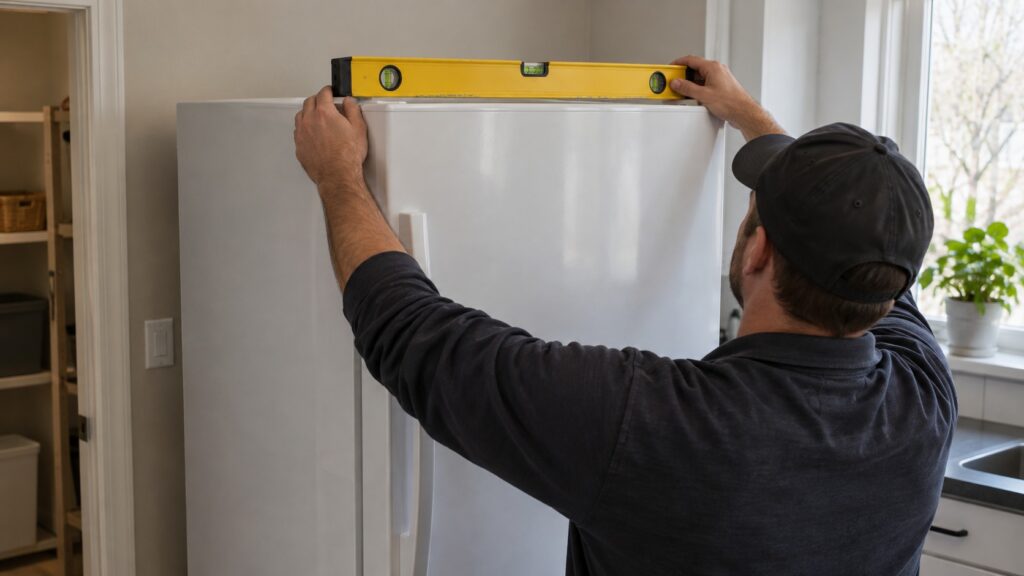
Use a level on the top of the cabinet and adjust the feet rather than shimming. Many designs want a very slight backward tilt so doors swing closed on their own — the manual will say. Then check that a door left a few inches open swings shut without help, and that the gasket contacts evenly all the way around.
If the doors need to open the other way for the room, reversing them is a defined procedure rather than an improvisation, and it is best done before the appliance is in its final position. Our guide on reversing a door covers the sequence.
Power, and what not to do
The third row is worth repeating, because energy-saving advice on the internet suggests otherwise. A refrigeration appliance manages its own cycling; cutting its power on a schedule shortens its life and risks the food inside.
Switching on for the first time
Let the appliance stand upright for the time the manual specifies before plugging it in. This lets oil that moved during transport settle back into the compressor, and skipping it is one of the few installation mistakes that can permanently damage a new machine.
Then run it empty until it reaches temperature, which takes several hours on a large cabinet. Only then load it, and load it gradually rather than filling it with warm food in one go. If you are transferring from another freezer, move the food in insulated bags and put the fullest drawers in first — a freezer holds temperature better when it is comfortably full.
Noise belongs in the placement decision too. A freezer against a shared wall with a bedroom or a home office transmits compressor vibration into the structure, and no appliance is quiet enough to make that pleasant at three in the morning. Where the room leaves a choice, put the cabinet against an internal wall with something solid behind it rather than a stud partition, and make sure nothing on top of the appliance can buzz against it when the compressor starts.
Garages, basements and cold rooms
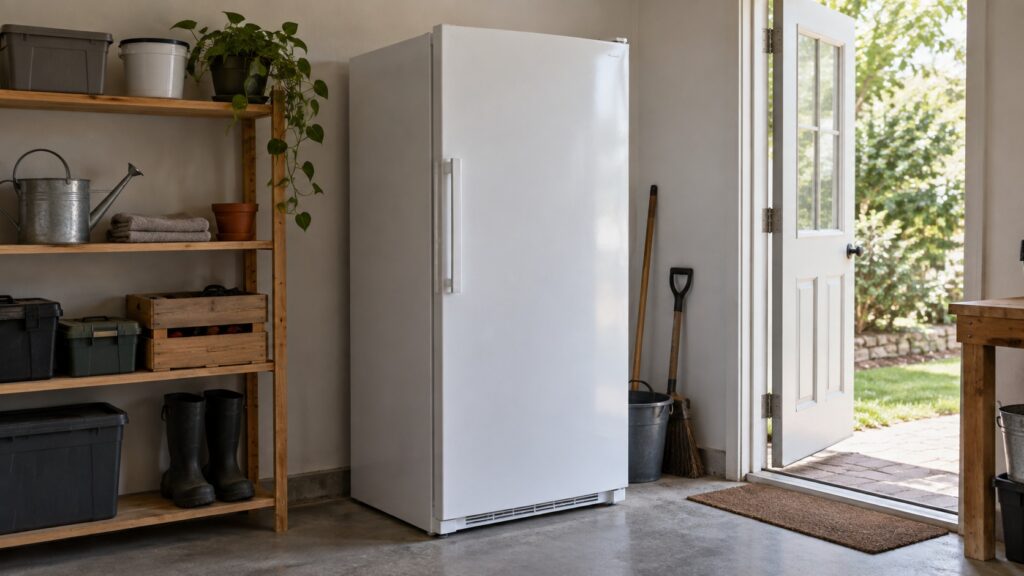
An appliance in an unheated space is a specific case. A cabinet designed for a warm kitchen can behave oddly when the room itself is near or below the target temperature: the thermostat sees a cold room and may cycle less, letting a freezer compartment warm up. If the appliance will live in a garage or an unheated basement, check that its climate class covers the temperature range of that room.
The same is true in reverse for a hot garage in summer, where the appliance runs almost continuously. Neither of these is a fault — it is an appliance being asked to work outside the range it was designed for.
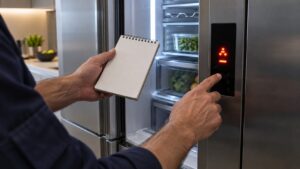
Write down the settling time before you throw the packaging away. It is printed on the documentation that arrives with the appliance, it differs between models, and it is the one instruction that cannot be recovered once the box is gone. Plugging in a large cabinet too soon after transport is the rare installation mistake that does permanent damage, and it is entirely avoidable with one note on the calendar.
When to call
Call when a new appliance will not reach temperature after a full day, when it runs constantly from the first week, when a door will not seal or self-close after leveling, or when you want the clearances checked before a built-in niche is closed up. The first month is when an installation problem is cheap to fix.
We are an independent repair company and not a factory service arm. Pricing starts from a diagnostic visit, and we confirm the estimate before any work begins. Liebherr freezer repair covers compressors, fans, defrost systems, sensors and door hardware, and you can schedule a visit online.