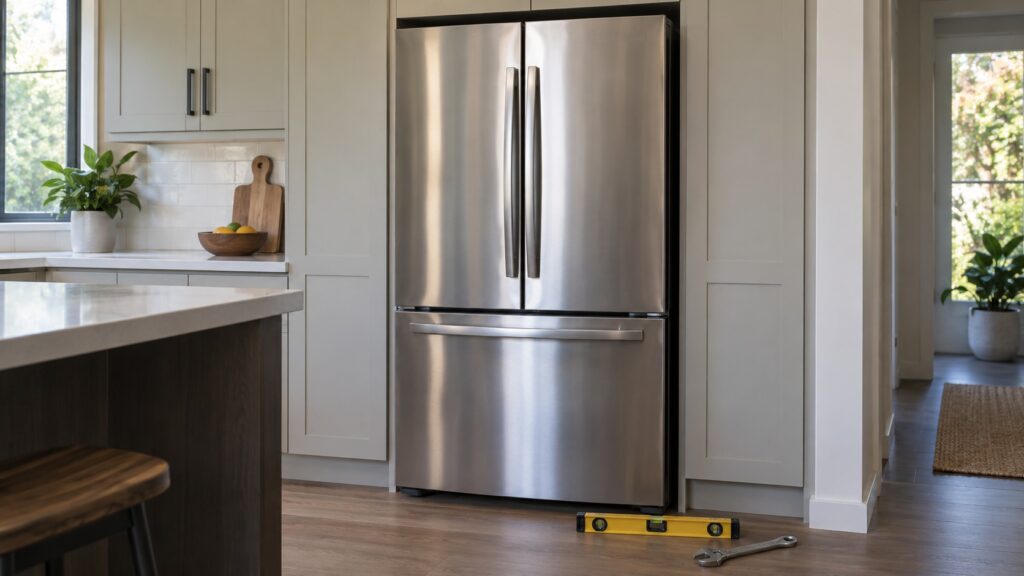
This is how to level Liebherr refrigerator cabinets: place a spirit level on top of the cabinet, check it side to side and front to back, and turn the adjustable feet until the cabinet is true. Many designs want a very slight backward tilt so the doors swing shut on their own; your manual says whether yours does. Then open a door a few inches and let go. It should close without help, and the gasket should touch evenly all the way around.
Why does a refrigerator need to be level?
A refrigerator that leans the wrong way works against its own doors. The hinges are set so that gravity helps the door close, and if the cabinet tilts forward the door drifts open, while a cabinet tilted too far back can make a heavy door hard to open. A door that sits slightly ajar lets warm, humid air flow in, and that shows up as moisture on the rear wall, frost, a compressor that runs a lot and, sometimes, a door alarm. Our guide to condensation inside a Liebherr fridge lists an out-of-level cabinet next to a worn seal as a cause that leaves the gasket undamaged.
Levelness also matters for the inside. Drawers run on runners that assume a flat cabinet, and shelves and bins sit better when the cabinet is true. A drawer that slides open on its own or will not stay shut is often a leveling problem before it is a part problem.
How do you level a Liebherr refrigerator step by step?
- Empty the door bins and shelves as far as you can, so there is less weight to shift while you work, and have a second person on hand for a tall or heavy cabinet.
- Place the spirit level on top of the cabinet, or on a shelf if the top is not reachable, and read it side to side, then front to back.
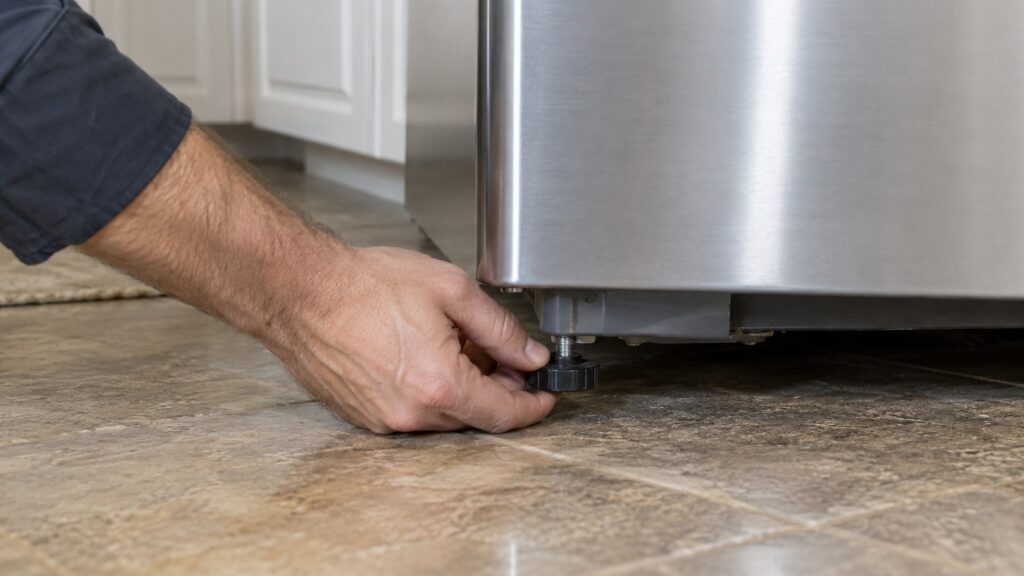
- Find the adjustable feet at the base. On many models they are reachable from the front, and the manual shows how to turn them.
- Turn the feet a little at a time and re-check the level after each change. Small adjustments are easier to correct than large ones.
- If your manual calls for a slight backward tilt, set that, and confirm the cabinet is still firm on all four corners and does not rock.
- Open a door a few inches and let go. It should swing shut on its own. Then close the doors and run the paper test described below.
- Put the food back and check again after a day, because the load changes how the cabinet sits.
Adjust the feet rather than shimming. A shim slides, compresses and eventually drops out, and the cabinet ends up resting on whatever is left. If the feet do not have enough travel to correct the floor, the floor needs attention, not a stack of cardboard.
How do you test that the doors and gasket now seal?
Close the door on a strip of paper and pull it. It should grip. Do this at several points around the opening, including the corners, and repeat on every door. A point where the paper slides out freely is a point where air is walking in. Clean the gasket with warm water first, since sticky residue holds a seal open as surely as damage does, and see our guide to Liebherr door seal replacement if a section is torn or hard.
If the cabinet is level, the seal is clean and the door still hangs low or will not seat, the problem is no longer leveling. A sagging door or a worn hinge is a technician job, and we do not recommend adjusting hinge hardware yourself on a heavy door.
What about clearances and the floor?
Levelness is one of three installation measurements. The others are the gap behind and above the cabinet and the route the appliance took to get there. Every refrigerator pushes heat out of a coil at the back or underneath, and a tight alcove recirculates that heat. Our installation and clearances guide covers the clearances, and the same rules apply to a combination refrigerator. The exact gaps are in your manual.
Check the floor too. A soft or uneven floor, such as one with a slope toward a drain, can move the cabinet after you level it. If the feet run out of travel, say so to the installer or a technician instead of forcing the feet beyond their limit. Do not tilt the cabinet far to reach the feet; use the method the manual shows.
Is leveling different for a built-in or integrated model?
Yes. A column or integrated refrigerator sits in a niche, and its leveling is tied to the cabinetry around it and, on an integrated model, to the furniture door that hangs from it. Leveling in a niche, adjusting the feet from the front and checking the alignment of the door panel are jobs for an installer. Our Monolith column installation guide describes the niche requirements, and the door-fitting work is covered in the manual. If an integrated door is out of line, call for a visit.
When should you stop and call someone?
Stop if the cabinet rocks and the feet are out of travel, if a door still will not close after leveling, if the unit is heavy enough that you cannot move it safely, or if you suspect the floor has moved. Do not lay the unit on its side to reach the feet. If you move it, note the settling advice in the manual before you switch it on again. Our refrigerator repair page explains what a visit covers.