A Liebherr fridge warm but freezer cold usually means the fault is in how cold reaches the refrigerator compartment, not in the whole appliance. Start with the simple causes: the fridge set point, a boost or special mode left on, a door or drawer that is not closing, blocked air vents, and a worn seal. If those are clear and the fridge stays warm while the freezer holds temperature, the cause is more likely a sensor, a frozen evaporator or a part in the cooling path, and that needs a technician.
Why would a Liebherr freezer stay cold while the fridge warms up?
Because the two compartments are cooled and controlled separately. On models with DuoCooling, the fridge and the freezer have two independent cooling circuits, and our DuoCooling explained guide notes that a problem in one circuit does not necessarily affect the other. A single circuit that underperforms usually points to a sensor or a sealed-system issue in that loop. That is a useful diagnostic clue: if the freezer is fine and only the fridge is warm, the freezer circuit is probably doing its job.
On a model without separate circuits, your fridge depends on cold air that has to travel to it, so blocked airflow is a more likely suspect. We have no model-specific wiring or airflow diagram on this site, so check your owner’s manual or the model page to see which design you have. The Liebherr model number decoder helps you read the name on the rating plate.
What should you check first on a warm Liebherr fridge?
These checks take minutes and need no tools.
- Set temperature. The recommended starting point for the fridge is about 39°F (4°C), per our temperature settings guide. Let a new setting settle for 24 hours before judging it.
- Special modes. Make sure SuperCool has switched off after its cycle, that no holiday mode is active and that the unit is not in demonstration mode, which keeps the display lit but disables cooling. See Liebherr demo mode.
- Doors and drawers. Close every door and drawer fully, and make sure nothing on a shelf holds a door ajar.
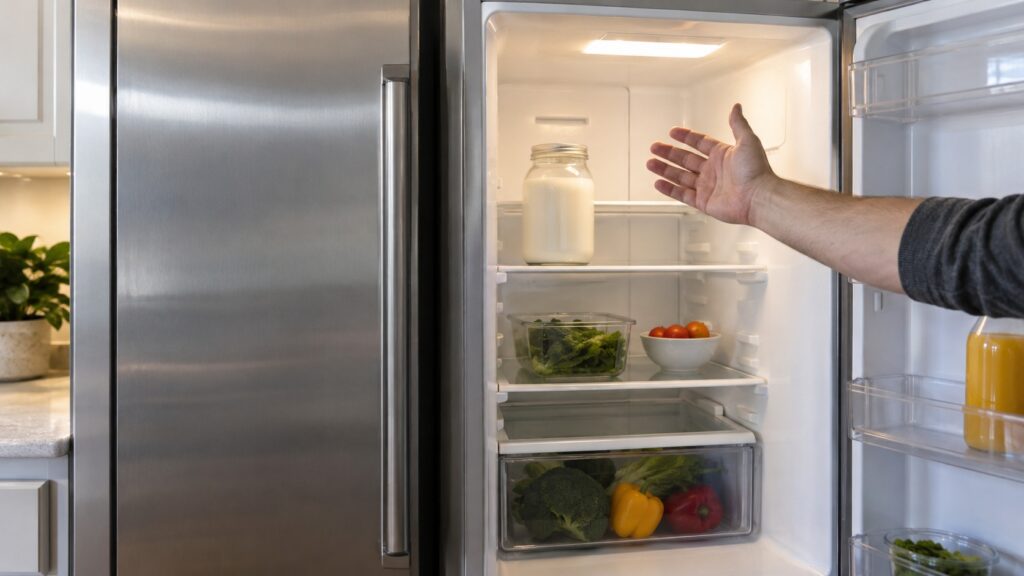
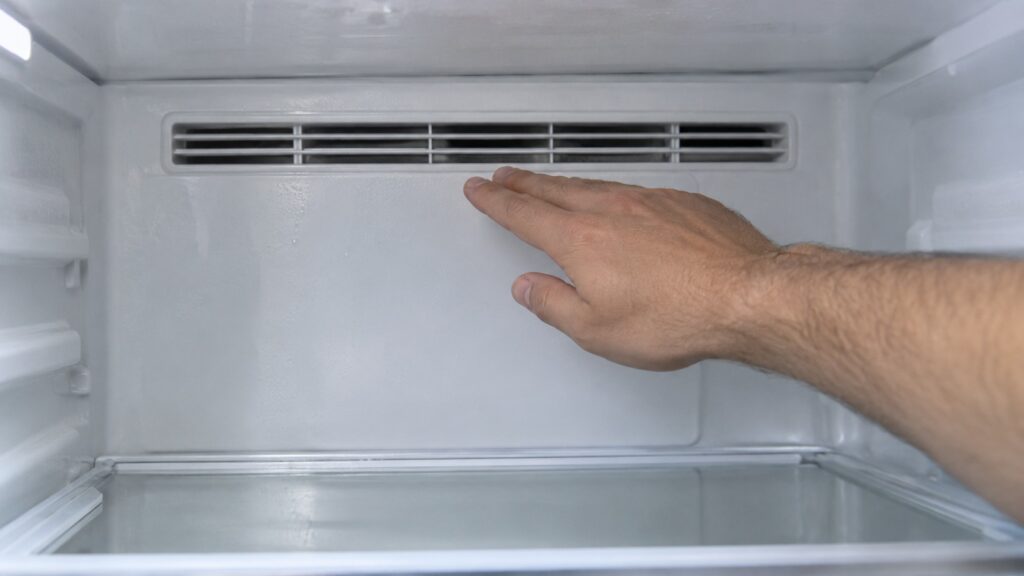
- Vents and loading. Move food away from the rear and internal air vents. A packed shelf in front of a vent can create a warm pocket.
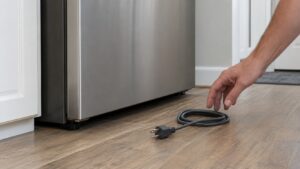
- Recent outage or restock. After a power cut or a big grocery load, give the unit several hours to recover with the door closed, as described on our warm after power cut page.
Could the door seal be making only the fridge warm?
Yes. The refrigerator compartment is the one you open most, and it is the one a leaking seal affects most visibly. A torn, hardened or dirty gasket lets warm, humid air in, which shows up as warmth, condensation or frost near the door edge. Close a sheet of paper in the door at several points around the frame; if it slides out easily anywhere, the seal is not gripping there. Wipe the gasket with warm water and mild soap and check that the cabinet is level so the door closes on its own. Our door seal replacement guide explains the paper test and a new gasket, and fridge condensation inside covers the moisture it causes.
What if there is frost on the back wall of the fridge?
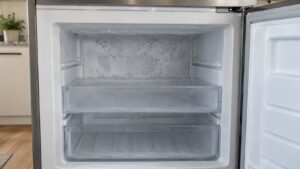
Frost on the rear wall or the evaporator means moisture is freezing where it should not, and it can choke airflow so the compartment warms gradually. Our refrigerator frost buildup page lists the usual causes: a door seal leak, a defrost problem, a blocked defrost drain and frequent door openings. A frozen evaporator can also be the result of a sensor reading wrongly. Do not chip ice with a knife or use a heat source against the liner; empty the compartment, switch the unit off and let it melt naturally if you decide to defrost. For a NoFrost freezer the same approach is in how NoFrost avoids defrosting.
What does an F2 code mean when the fridge is warm?
Our refrigerator F2 page says it points to an evaporator sensor failure: the evaporator thermistor governs defrost timing and cooling regulation, and when it reads out of range the fridge may cool weakly or let the evaporator ice over. Our F1 to F4 sensor-code guide adds that the number means different sensors on different appliances, so confirm the appliance before ordering a part, see Liebherr F2 error. The safe owner steps are to write down the appliance and code and to cut power for two minutes and restart. Opening the rear panel or the evaporator area is not a home job.
When should you call a technician, and what about the food?
Call if the fridge is still warm after the checks above, if it is warm with a correct setting and clear vents, if an F-series code returns, or if frost keeps coming back. Sealed-system problems such as a refrigerant leak or a compressor fault are never a do-it-yourself job. If you see water near electrical parts or smell burning, switch off the breaker from a dry floor and stay clear of the cabinet.
Keep the doors closed as much as possible. A closed refrigerator keeps food safe for about 4 hours without power, and food held above 40°F (4°C) for longer should not be kept, so use a thermometer in the warm compartment and move perishables to a cooler if needed. You can read the wider checklist in Liebherr fridge not cooling or go straight to Liebherr refrigerator repair.