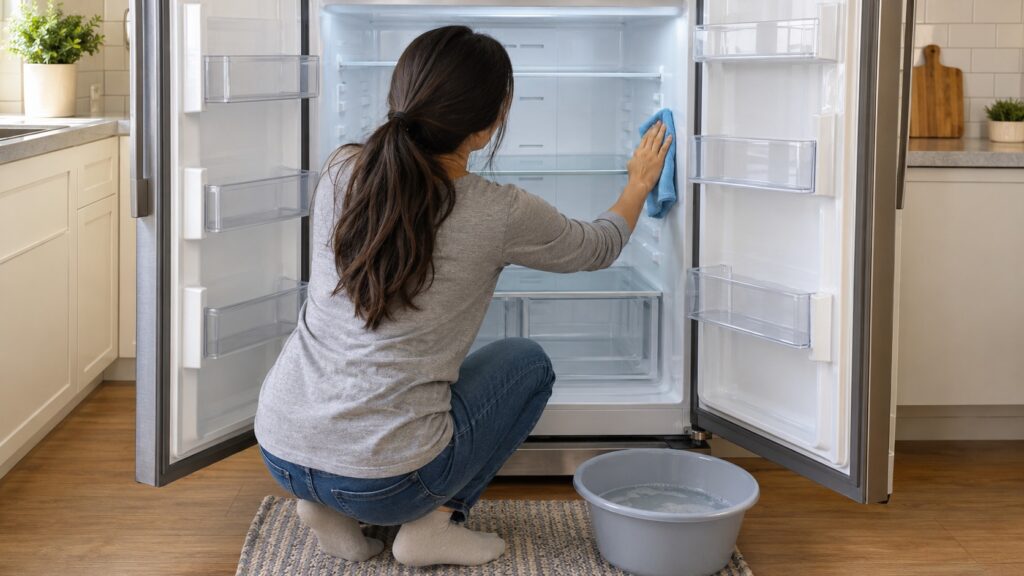
Here is how to clean Liebherr refrigerator interiors: take the food out, lift out the shelves and drawers, wash them in warm water with a little mild dish soap, wipe the cabinet walls and door gaskets with a soft cloth, and dry everything before it goes back. Skip abrasive pads, harsh chemicals and scented sprays. Let glass come to room temperature before it meets warm water, and keep water away from the lights and controls.
How often should you clean a Liebherr refrigerator inside?
Wipe up spills when they happen, and give the whole interior a proper clean on a routine you can keep. Our annual maintenance checklist puts a full interior wash into the yearly routine, and our BioFresh drawer guide covers the humidity drawers in more detail. A household that stores strong cheese, fish, cut onion or raw meat should clean more often, because those foods leave smells and residue sooner. If the cabinet smells even after cleaning, the odor filter is the next suspect; see the section below.
What do you need before you start?
A cooler or an insulated bag for the food, a clean soft cloth, a second cloth for drying, a basin or sink of warm water with a little mild dish soap, and something to protect the floor from drips. Choose a time when the cabinet is nearly empty, such as before a big shop. Keep the door closed whenever you are not working, and move quickly with chilled food so it does not sit out. Perishable items should go straight into the cooler.
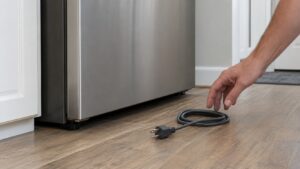
Whether to switch the refrigerator off for the clean is a model question. Many owners leave it running and work quickly; others switch the unit off using its own on and off function first. The owner’s manual for your model says which it prefers, and if you switch it off, switch it back on afterward and confirm it is cooling.
How do you clean the shelves, drawers and bins?
Lift out the shelves and drawers. Our guide to Liebherr refrigerator shelves shows the way: empty the shelf, lift the front slightly, tilt it and draw it out of its supports. How a drawer comes off its runners differs by model, so check the owner’s manual before you pull one out. Wash them in the sink with warm water and a little dish soap. Do not put drawers in a dishwasher, because heat can warp them. For the humidity drawers, our BioFresh drawer cleaning guide has the full sequence, including wiping the runners and drying everything fully before refitting.
Glass shelves are the one place to slow down. A shelf that has been sitting in a cold cabinet should come to room temperature before it is washed, and the water should be warm rather than hot. Sudden temperature change is the usual way a good shelf is lost. Door bins and racks are worth a look too: a cracked bin is a part to order, not something to tape, because a fragment that falls behind a drawer can stop it closing.
How do you clean the walls, the door gasket and the drain area?
Wipe the cabinet walls and ceiling with a cloth wrung out in the soapy water, working from the top down so drips run onto surfaces you have not yet done. Follow with a second cloth wrung out in plain water to remove soap residue, then dry. Never spray liquid straight at the light, the display or any control. Wring the cloth until it is damp, not wet.
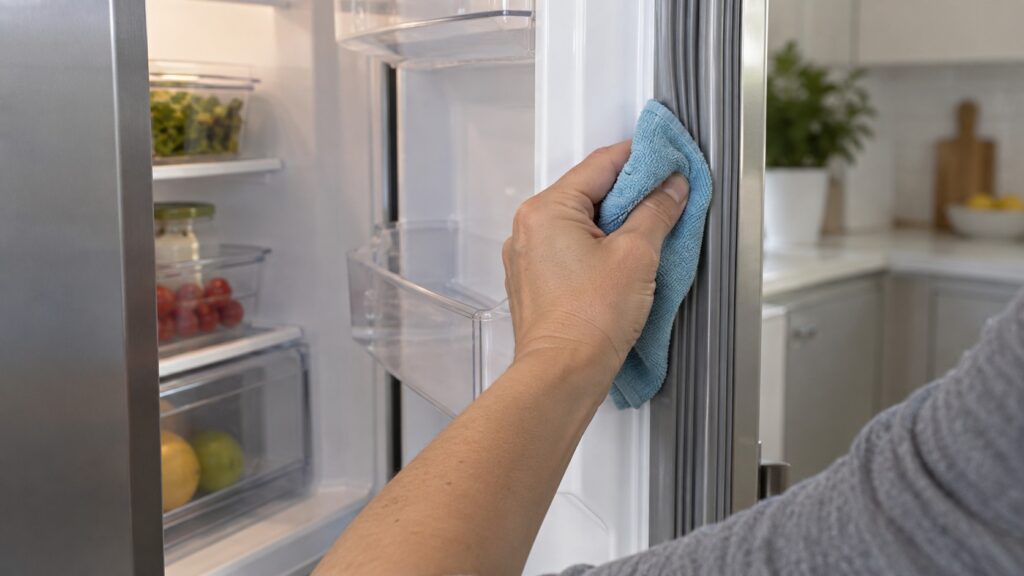
The door gasket is where grime hides and, since a sticky seal does not close properly, it is worth cleaning with the same warm water. Wipe the folds of the gasket, not just the face. Then run the paper test: close the door on a strip of paper and pull it, at several points, and see our door seal replacement guide if a section is torn or hard. If your model has a small drain hole at the base of the rear wall, look at it. If water or debris has collected at the base, clear it gently with a cotton swab and warm water, never with wire.
What should you avoid putting on the interior?
Avoid abrasive pads and powders, which scratch the plastic and leave a rough surface that holds residue. Avoid chlorine cleaners and strong solvents, which can mark plastics and leave a smell that the food then picks up. Avoid heavily scented products, since a refrigerator is a closed box and whatever you use stays in it. Baking soda dissolved in warm water is a gentler choice for odors than a stronger cleaner. Do not use a steam cleaner or a high-pressure spray on the interior. If you are unsure about a product, test it on a small hidden spot or use plain warm water.
Stainless and black exteriors are a separate matter. Our glossary of interior features also covers the finishes and what each one asks of you, and the outside should be cleaned the way the finish requires, not with whatever you used inside.
Does the odor filter need attention?
If the cabinet smells even after a thorough clean, the activated-charcoal filter may have given out. It is a consumable that gives no warning when it saturates, and the manual lists how often to replace it. Our FreshAir filter guide describes where it sits and how to change it. A persistent smell with a fresh filter and a clean interior usually means something has run under a drawer or down into the base, and that is worth a closer look.
When should you call a technician?
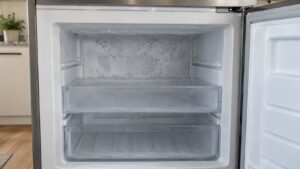
Cleaning is an owner job, but some findings are not. Water that keeps pooling after you clear the drain, heavy frost on the rear wall, a gasket that is torn, a light or control that stops working after cleaning, or a cabinet that will not hold its temperature should be looked at. Do not open panels to chase any of them; that is a technician’s job. If water reaches a socket or you smell burning, switch off the breaker at the panel while standing on a dry floor, and do not pull a plug from a wet outlet.