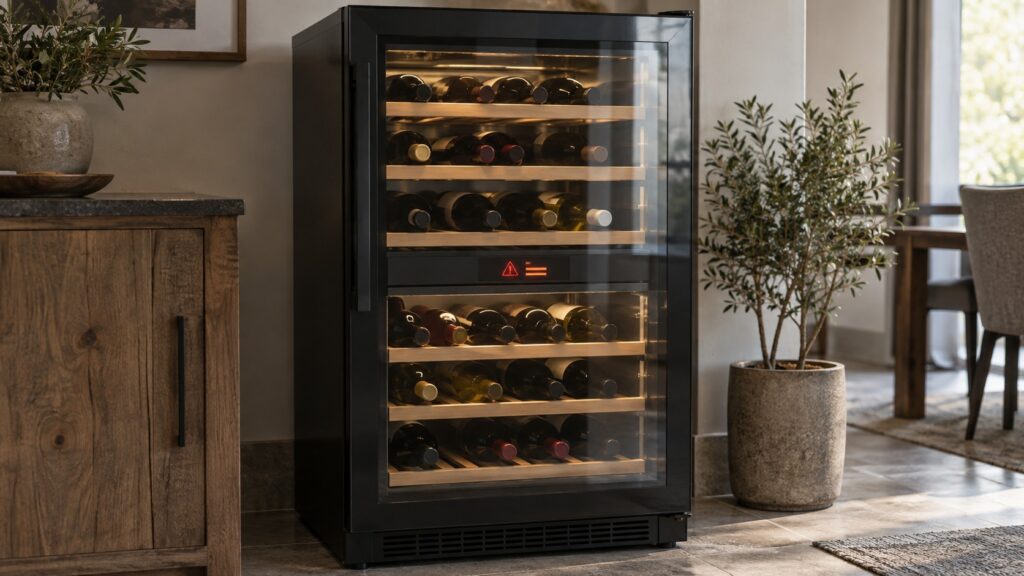
Liebherr wine cooler error codes split into two families, and the split is the whole diagnosis. F1 is a failed temperature sensor: the unit has lost the probe that reads a zone. E0, HI and LO are temperature alarms: the probe is fine and is reporting that a zone has gone outside its band. DOR is a door alarm. A sensor fault needs a part; an alarm needs an explanation, and on a wine unit the explanation is usually the room, the load or the glass door rather than the refrigeration.
What does F1 mean on a Liebherr wine cooler?
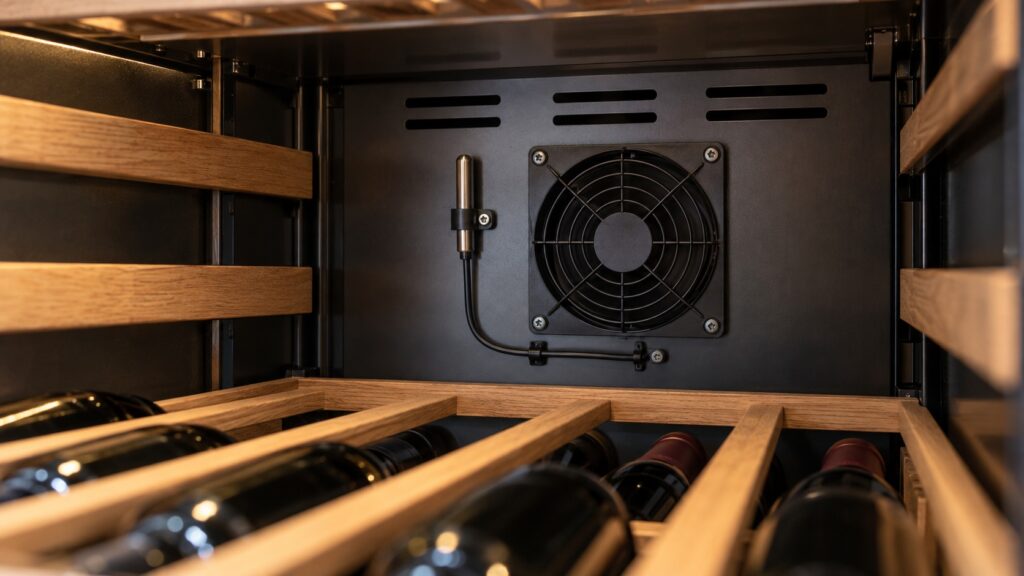
F1 is a temperature sensor failure. Each controlled zone in a Liebherr wine unit has its own probe, and the control converts the probe’s resistance into the number you see. When that value stops being believable — a broken lead, a corroded connector, a failed bead — the control raises F1 and falls back on a timed program.
The reason this matters more in a wine unit than in a kitchen refrigerator is the band. A fridge asked for 37 degrees Fahrenheit is forgiving about a few degrees either way for a day. An aging cabinet is holding a single steady temperature for years, and the damage from a fallback program is not spoilage you can see but a slow cycle of expansion and contraction under the cork. Treat F1 as urgent even though nothing smells wrong.
The detail on this one code is on the F1 sensor page for wine units. If you are not sure what band your unit should be holding in the first place, the ideal wine storage temperature sets it out.
What is the difference between E0, HI and LO?
All three are alarms, and they differ in what they are telling you about direction and severity. E0 is the general temperature alarm: a zone has been outside its band long enough for the control to stop treating it as normal. HI and LO name the direction — too warm and too cold — and that single piece of information changes where you look.
HI points outward, at heat the unit cannot get rid of: a room that has warmed up in summer, a built-in installation whose ventilation gap has been blocked by cabinetry or a rug, a condenser coated in dust, a glass door in direct sunlight for part of the afternoon, or a case of room-temperature bottles loaded all at once. A unit asked to pull two dozen bottles down from 70 degrees will show a high alarm for a day and is not faulty.
LO points inward, and it is the one that costs you bottles. A zone running below its setting freezes wine at around 20 degrees Fahrenheit, pushes corks and leaves a sticky trail down the neck. The usual causes are a setting entered on the wrong zone, an ambient temperature below the unit’s rated minimum in an unheated garage or basement, or a control that is being told the wrong value.
The individual pages carry the checks for each: the high-temperature alarm and the low-temperature alarm.
Why does my wine unit show DOR when the door is closed?
DOR is a door alarm, and on a wine unit it earns its own paragraph because the door is glass, heavy and hung on a narrow cabinet. Three things trigger it with the door apparently shut.
First, a shelf or a bottle neck standing proud of the front rail, holding the door a fraction open — enough for the switch, invisible from across the room. Second, a gasket that has taken a set after years of closing against a warm room, especially near the bottom corner. Third, a unit that has shifted out of level, which on a built-in with a tall glass door is enough to stop the door swinging fully home.
Check in that order, with a sheet of paper: close the door on it at four points and pull. Paper that slides out freely anywhere is a seal or a level problem. The door alarm page covers the switch itself for the case where the door is genuinely sealing and the alarm still fires.
Why do my two zones disagree with each other?
A two-zone Liebherr — a Vinidor with independent zones, or a serving unit split between white and red — can show an alarm on one zone while the other behaves perfectly. That pattern is informative rather than confusing: a fault in the compressor or the sealed system would drag both zones, so one bad zone and one good one points at that zone’s own probe, damper or fan.
Before assuming hardware, check the obvious human cause. Zones are set separately, and the commonest cause of a low alarm is a serving temperature meant for white wine entered on the zone holding reds. Our guide to setting up Vinidor zones covers which control belongs to which compartment, and uneven cooling in a wine fridge covers the case where the numbers are right and the bottles still disagree.
What can I check before calling, and what needs a technician?
Work through the room first, because in a wine unit the room is half the appliance. Give the cabinet its ventilation gap back. Vacuum the condenser grille. Keep sun off the glass. Leave a new load two full days before judging a high alarm. Confirm the setting on each zone with your own eyes rather than from memory. Check the door with the paper test. None of that requires a tool, and it explains most alarms.
What needs a technician: F1 on any zone, a low alarm that persists in a room at normal temperature, an alarm that returns after the room and the load have been ruled out, a compressor that runs without ever stopping, or ice appearing on a rear wall. Those are probes, dampers, fans and sealed-system questions, and a wine unit full of bottles is not a good place to experiment. Do not unplug the unit overnight to reset it either — the alarm will clear and the bottles will warm.
We are an independent repair company, not a factory service arm. Pricing starts from a diagnostic visit and we confirm the estimate before any work begins. Liebherr wine refrigeration repair covers zone sensors, fans, door hardware and controls, and you can schedule a visit online or call 1-844-731-4681.