How a Liebherr ice maker works is a loop of four steps. It lets a measured amount of water into a mold, freezes it with cold air from the freezer, releases the cubes into a bin, and stops when a sensor says the bin is full. Nothing in that loop is complicated, but each step depends on the one before it, which is why a slow or empty ice bin almost always traces back to water, cold air or the release step rather than to the whole machine.
How does a Liebherr ice maker make ice?
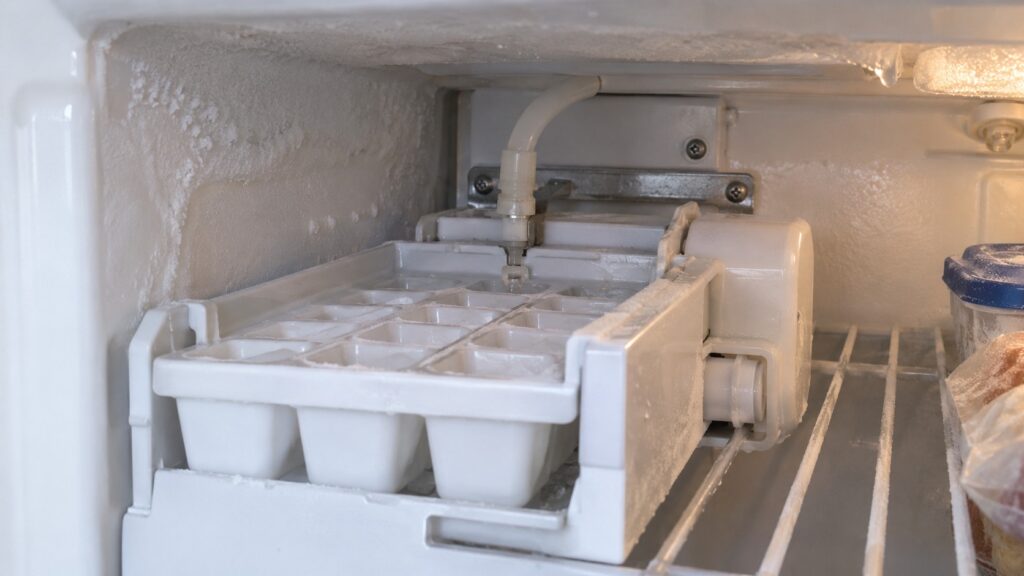
When the freezer is cold enough and the ice maker is switched on, the control sends a signal to open the water valve for a few seconds. That brief fill is timed rather than measured by a float, so the amount of water depends on how long the valve stays open and on the pressure in the supply line. The water settles into the mold, and the freezer fan pushes very cold air across it. A temperature sensor on the mold tells the control when the water has frozen solid, and only then does the release step begin.
The loop repeats until the bin is full. At a typical household setting that means a few batches an hour once the system is up to temperature, which is why ice is slow for the first day after installation and why a freshly emptied bin takes hours to refill. Our ice maker troubleshooting guide explains what a normal pace looks like and what counts as slow.
Where does the water come from?
Depending on the model, the ice maker is fed either from the home’s cold water line or from a tank you fill yourself. A plumbed model has a supply tube, a shutoff valve and, on many installations, a water filter in the line. A tank model draws from its own reservoir and stops when the tank runs dry. Check your manual to see which one you own, because the troubleshooting for each is different: a tank model that has stopped making ice usually just needs water, while a plumbed model may have a closed valve or a clogged line.
On plumbed units the water quality shows up in the ice. Hard water leaves mineral film on the mold, and a filter that has not been changed in a long time restricts flow so the fill step delivers too little water. Our water filter replacement guide covers the schedule, and the ice will tell you if you are overdue: small, hollow or cloudy cubes are a classic sign.
Why does the freezer temperature matter so much?
The ice maker has no refrigeration of its own. It borrows cold from the freezer, so a freezer that is running too warm freezes the mold slowly and cuts production. The reverse also helps: a freezer set to a lower temperature produces ice faster, at the cost of a little more energy. If you have just switched on SuperFrost to freeze a large load, the ice maker may speed up for a while as well, because the compartment is colder than normal. Our SuperFrost explanation shows what that function changes.
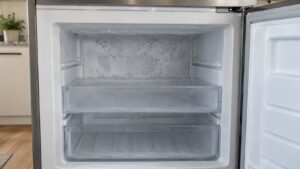
Frost matters too. On NoFrost models the freezer air is kept dry, which helps keep the ice maker clear of ice build-up around the mold. If the freezer is frosting over, ice production usually suffers before the frost becomes visible. Our NoFrost explanation shows how the system stays dry.
How are the cubes released into the bin?
The release step is the one that most often goes wrong, because it involves movement. On many household ice makers the mold is warmed briefly to loosen the cubes, or flexed so they pop free, and a small mechanism then tips or pushes them into the bin. The control watches for the mold to finish its cycle before it begins the next fill. If the cubes stick, the mold does not clear, and the next fill overflows or stops. That is why a jam can look like a water problem when the real cause is a stuck release.
Never reach in and pull on the mechanism. The parts are small, they are driven by a motor, and forcing them can bend the mold or strip a gear. If a mold will not clear, switch the ice maker off in the display, let the freezer stand closed for a short time, and book a technician if the fault returns.
How does the machine know the bin is full?
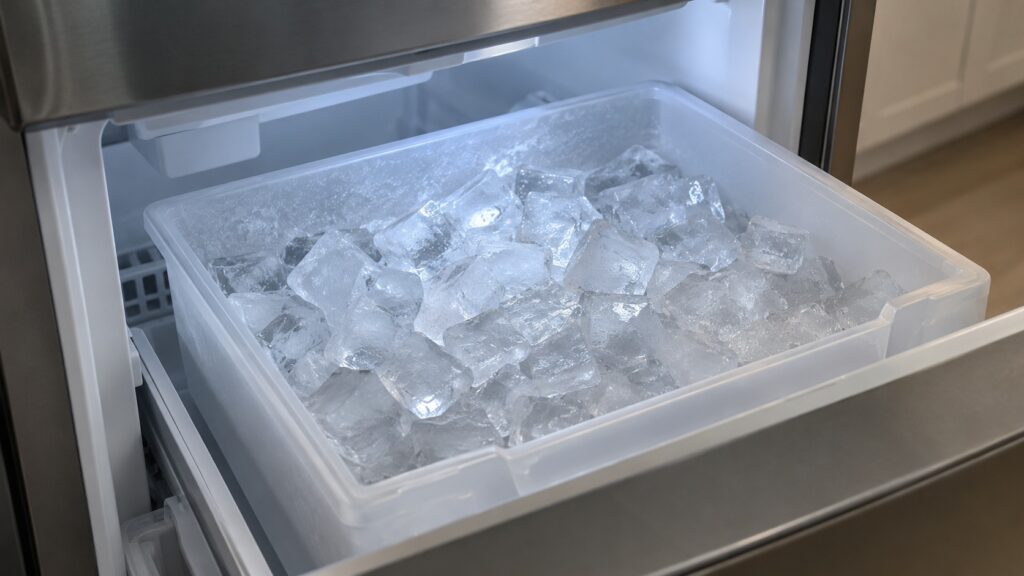
A sensor or a feeler near the bin checks the level of the cubes. When the bin is full, the control pauses the loop and waits. When you take ice out and the level drops, the loop restarts. If ice builds up in a high pile under the mold, the sensor can read full while the bin is only half full, so shake the bin level now and then. Our clear ice tips describe how to keep the output good and the bin clear.
An ice maker also needs regular cleaning, because anything that touches water and sits in a cold, dark space will collect film. Our ice maker cleaning guide shows a safe routine, and it is worth reading before you decide a machine has failed.
When is the ice maker the fault, and when is the fridge?
Treat the ice maker as a guest of the freezer. If the freezer is warm, the fault is the freezer, and the ice maker is only the first place you notice it. If the freezer is cold and the water supply is fine but the loop still stalls, the fault is in the valve, the sensor, the heater or the mold. If you are weighing a repair on an older machine against replacing it, our guide on whether to repair or replace a Liebherr ice maker explains how to decide. For anything involving the water line or electrical parts, our refrigerator repair service can diagnose it.