To see how a Liebherr Monolith freezer works, picture a tall built-in freezer cabinet that cools with a sealed refrigeration circuit, keeps frost off your food by moving dry air past a hidden coil, and sheds its heat through ventilation channels in the niche instead of through the back. A Monolith freezer column is a full-height, fully integrated unit that becomes part of your cabinetry. This guide explains how the cold is made, how NoFrost keeps the drawers clear of ice, and what that means for the way you use and install the column. It does not cover installation steps or model repairs.
What is a Liebherr Monolith freezer column?
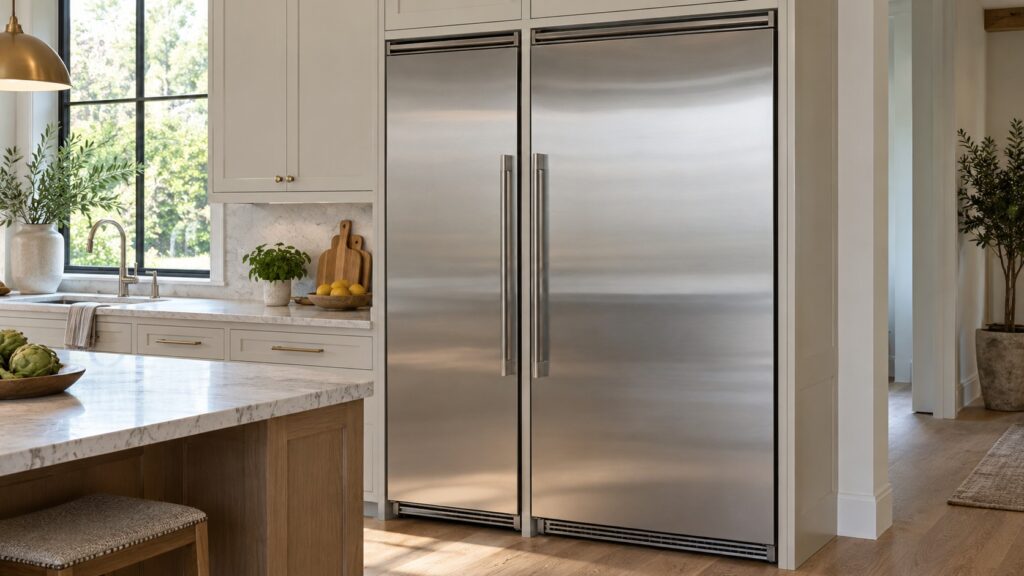
A Monolith is a floor-to-ceiling built-in appliance that sits flush with the cabinets. Our site lists four freezer columns: the MF 2400 and MF 2410, each 24 inches wide, and the MF 3600 and MF 3651, each 30 inches wide. Their model pages describe them as built-in freezer columns with NoFrost, PowerCooling air circulation, InfinityLight lighting, a SoftSystem soft-close door and a SmartDeviceBox for Wi-Fi. The pages list an integrated IceMaker with a fixed water line for these models. Whether a feature is on your exact unit is a question for your model sheet and owner’s manual. The model pages are also where the capacity and size figures live, so look them up there rather than guessing from the name.
Monolith columns come as separate refrigerator and freezer units. Our guide on Monolith columns vs a combination unit explains why some owners prefer a separate freezer column to a freezer compartment under the refrigerator.
How does the freezer make and keep cold?
Like every household freezer, a Monolith column uses a sealed refrigeration circuit. A compressor drives a refrigerant around a closed loop. The refrigerant picks up heat inside the cabinet at a cold coil called the evaporator and gives that heat up at a second coil, the condenser, outside the cabinet. The thermostat and sensors tell the control when to run the compressor, so it cycles on and off to hold the set temperature. The circuit is sealed and charged at the factory, which is why any work on it belongs to a technician.
A fan moves air across the evaporator and through the cabinet; that is the air circulation the model pages call PowerCooling. Because the air moves, the drawers cool evenly and a warm spot is less likely, as long as food is not packed against the vents. Our upright freezer organizing guide shows how to leave room for airflow.
How does NoFrost keep the drawers free of ice?
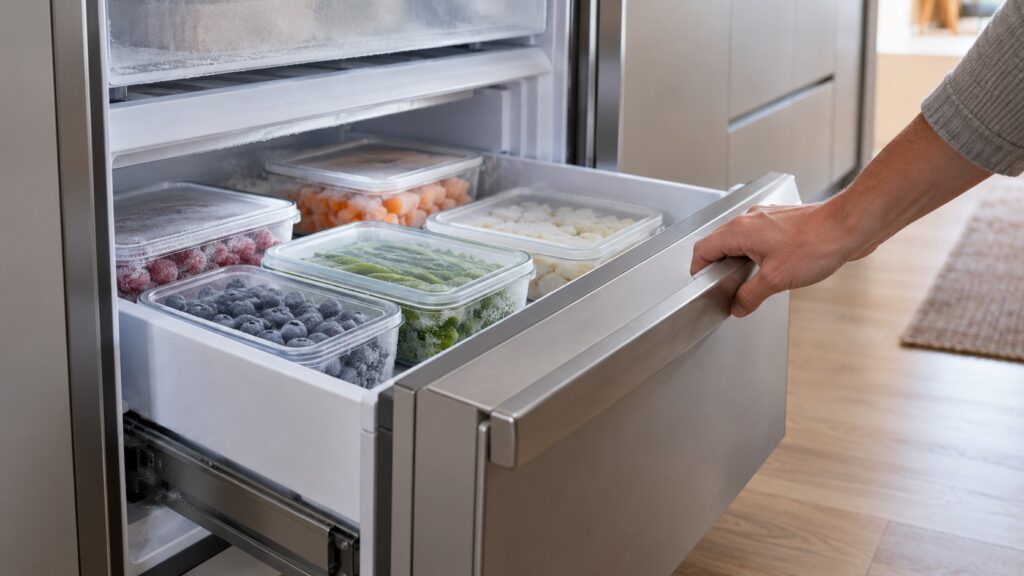
In a NoFrost freezer the evaporator sits behind the cabinet wall, not in the food space. The fan circulates cold, dry air over the food, so moisture does not settle on it. Any frost that forms collects on the hidden evaporator instead, and an automatic defrost cycle melts it and drains the water away. That is why you do not defrost the column by hand, and why circulating dry air also reduces freezer burn. Our guide on how NoFrost avoids defrosting goes through the mechanism in more detail.
SuperFrost is a different thing. It is an on-demand boost for large loads of fresh food, while NoFrost runs in the background all the time. If frost still builds up in a NoFrost freezer, that is a symptom, not normal. A worn door seal, a door left ajar or a defrost problem are the usual suspects, and our NoFrost defrosting guide explains how to clear existing ice safely.
Why does the column need a ventilation path?
An integrated column sheds heat through designated channels, not through the back, so the niche has to leave the free air path the installation sheet specifies. The heat from the condenser has to go somewhere. If the niche traps it, the compressor runs longer, the freezer works harder and wear increases. Our Monolith column installation guide says a poorly ventilated niche is the most common cause of a column running warm after install.
The same principle applies when you place two columns side by side: each still needs its own ventilation path. Our guide on combining Monolith columns covers the planning. Tall columns are anchored to the cabinetry with the supplied hardware, so installation and anchoring are jobs for an installer.
What do the door, light and Wi-Fi do?
SoftSystem is the soft-close hinge and damper that catches the door near the end of its travel and eases it shut. A door that closes fully matters in a freezer because a gap lets in warm humid air, which turns to frost. InfinityLight is the full-height LED lighting on the side walls. SmartDeviceBox connects the unit to your home Wi-Fi so it can send alerts to a phone; see our SmartDeviceBox guide for how that link works. A door-open alert and a temperature alert are the two you will find most useful on a freezer.
What each of these does on your exact model, and which keys or menus control it, is in the owner’s manual.
When should you call a technician?
Call if the column is not freezing, frost keeps returning after you have checked the seal, the door does not close by itself, or the display shows a code that does not clear. Do not open panels or reach into the cabinet back; that is a technician’s job. If you ever see water at the base, smell burning or hear electrical crackling, switch off the breaker at the panel while standing on a dry floor and stop using the unit. Our Monolith repair page explains how a visit works, and you can schedule a visit online. We are an independent repair company, not the manufacturer.