
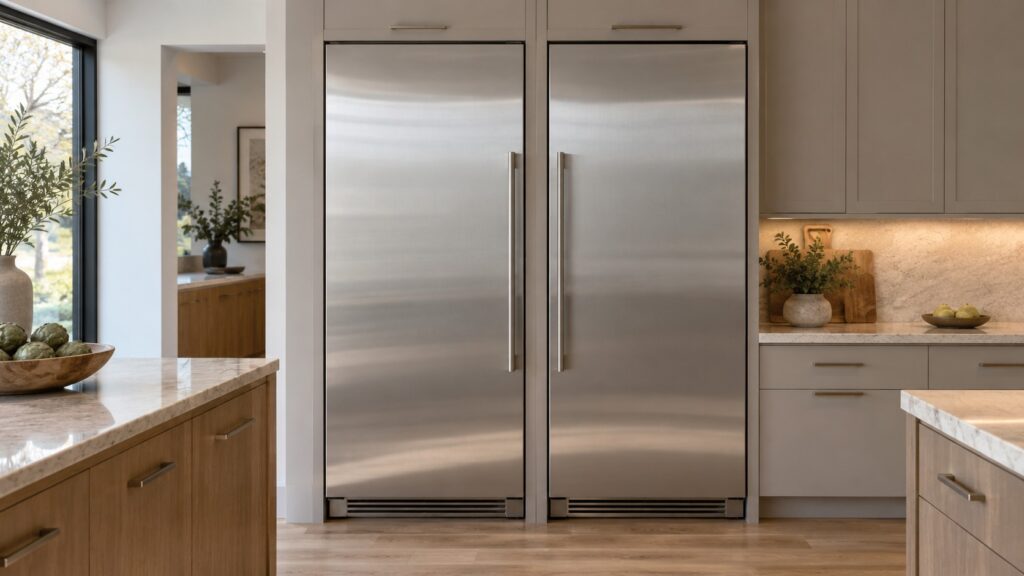
Liebherr vs Sub Zero refrigerator is a comparison buyers make when they are planning a built-in or integrated kitchen. We service Liebherr, not Sub-Zero, and we are an independent repair company, so this guide does not declare a winner, rate either brand or quote prices. What it gives you is a method: the questions that decide between any two premium built-in refrigerators, with the Liebherr side answered from our own model pages and the Sub-Zero side left for you to confirm on Sub-Zero’s current spec sheets and installation guides.
How should you compare Liebherr and Sub-Zero without a ranking?
Start from your kitchen, not from the badge. Write down the opening you have, the format you want and the features you will really use, then hold each brand’s documentation against that list. A premium refrigerator is a long-term purchase, and the best model for a given kitchen depends on dimensions, ventilation and how you shop and cook. We cannot tell you one brand is better, and a page that does is guessing.
Before you read any spec sheet, take these measurements: the width, height and depth of the opening, the clearance above and behind where air must flow, the swing space for the door in front, the distance to the nearest water line if you want an ice maker, and the width of the doorways the unit must pass through on delivery. Write the numbers down. A refrigerator that wins every feature comparison but does not fit the opening or the hallway is not the right refrigerator.
The rest of this guide goes through the criteria in the order that usually matters. For every criterion, the Liebherr facts come from the model pages and guides on this site, and for the other brand the right source is the maker’s own current documentation.
What formats does Liebherr offer, and what does each one commit you to?
Liebherr’s lineup on our site covers several formats. Monolith columns are floor-to-ceiling built-in units; for example, the MRB 4250 refrigerator column is listed at about 17.0 cu ft, 30 inches wide and 84 inches high, and the MRB 5510 at about 19.4 cu ft and 36 inches wide. The MT 1700 freezer column is 18 inches wide. An integrated combination such as the ICBNd 5163 is about 21.9 inches wide and listed as panel-ready, and a freestanding side-by-side such as the SBSes 8483 is 47.2 inches wide with an ice maker. These figures are approximate values from our model pages, so confirm exact cutout dimensions with the installation guide for your model.
The format drives the work around the appliance. Integrated versus freestanding explains the cabinetry, ventilation and replacement cost that come with a built-in, and Monolith columns versus a combination unit covers when separate columns make sense. Ask the same question of any Sub-Zero model you are considering: how wide, how tall, how much clearance and what ventilation does the cabinet need?
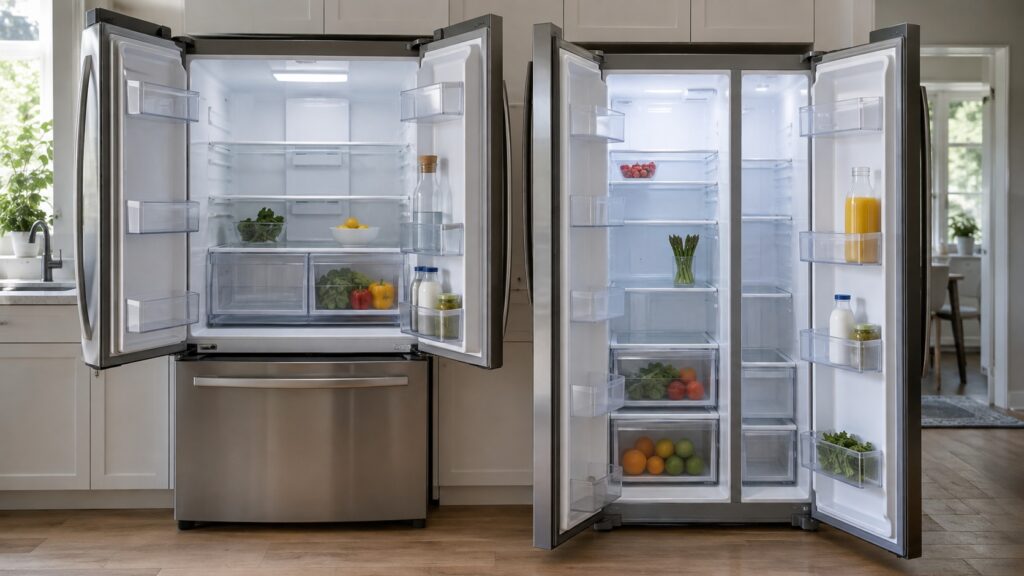
How do fresh food storage and cooling design differ between built-in refrigerators?
Look at how each design treats fresh food and how it cools the two compartments. On the Liebherr side, BioFresh drawers sit near 0°C (32°F) in a zone the appliance regulates separately, with HydroSafe for produce and DrySafe for meat and fish. DuoCooling gives a combination refrigerator and freezer two independent circuits, which our guide describes as meaning no shared air, no odor transfer and independent control of each section. The freezer side of many models is NoFrost, so it rarely needs defrosting.
For another brand, ask the same plain questions. Does it keep a separate fresh food drawer, and at what humidity? Is the freezer cooled by a separate system? Does the freezer defrost itself? Compare the answers from the spec sheet, not from a showroom summary.
What about finish, doors and panels?
Finish is the most visible choice in a built-in run. Liebherr offers stainless in two looks, a brighter brushed SteelFinish and a darker matte BlackSteel, and many integrated and Monolith models are panel-ready so cabinetry can cover the door. Our SteelFinish versus BlackSteel guide explains the choice. Monolith doors use SoftSystem soft-close, and the cabinets use full-height LED lighting; see the model pages for each unit.
When you compare, check which finishes each brand lists for the exact model you want, whether a custom panel is supported and how heavy the panel can be. Panel weight and hinge type are installation details that decide whether your cabinet maker can build the front you have in mind.
What about service, parts and connectivity?
These are the criteria buyers forget until something breaks. On a Liebherr, almost every part is specific to the model family, size class and generation, so the full model name and serial number on the rating plate are what get the right part ordered; our model number decoder shows how to read them. Built-in units also have to be pulled out of their opening for some repairs, which is part of the service picture. Connected models use a Wi-Fi module and an app, and network problems are far more common than appliance problems, as our SmartDevice alerts guide explains.
Ask any maker or dealer: who services this model in my area, how are parts ordered, and what does the app actually report? If a refrigerator you already own needs attention, our Liebherr refrigerator repair page explains how a visit works.