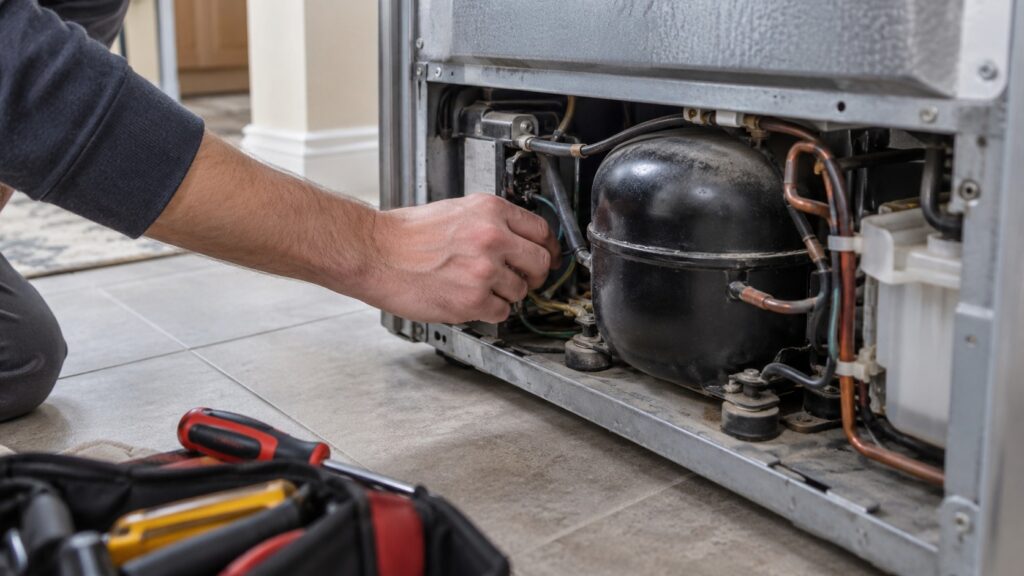
A Liebherr compressor repair or replace decision depends on what has actually failed. If the compressor itself has seized or lost its sealed-system pressure, the repair is large and usually pushes an older Liebherr toward replacement. If the compressor is fine and the fault is a start relay, a fan, a sensor or the control board, a repair is typically far cheaper than a new unit and well worth doing. A technician can tell the two apart in a single visit.
How can you tell the compressor is the problem?
The compressor is the pump that circulates refrigerant, and it fails in recognizable ways. A refrigerator that hums or clicks and never settles into a steady run, a cabinet that warms slowly over a day, or a back panel that is unusually hot all point toward the compressor circuit. A compressor that never starts may be waiting on a relay or the control board and is not necessarily dead. A compressor that runs without cooling suggests a sealed-system fault such as a leak or a blockage. Many other faults look similar from the outside, so a symptom alone is not proof.
Before you assume the worst, work through the basics in our Liebherr fridge not cooling guide. A blocked vent, an overpacked cabinet, a failing door seal or a defrost fault can imitate a compressor failure. Our strange noises guide helps with sounds, since a loud buzz can come from a loose part rather than the compressor.
What kinds of compressor faults are repairable?
Most of the parts around a compressor can be replaced without touching the compressor itself. The start relay and the overload protector help the compressor start and protect it from overheating, and either can fail while the compressor remains healthy. The condenser fan and the condenser coil keep the system from overheating, and a dirty coil or a stopped fan makes the compressor run hot and long. The control board and the temperature sensors tell the compressor when to run. Replacing any of these parts is usually far less than replacing the unit, and it often restores normal cooling.
Some Liebherr models use an inverter compressor that changes speed to match the load. That design is quiet and efficient, but it adds electronics to the circuit. If a model with an inverter compressor misbehaves, the fault can be in the drive electronics rather than the compressor. Our inverter compressor glossary entry explains the term.
When does replacing the unit make more sense?
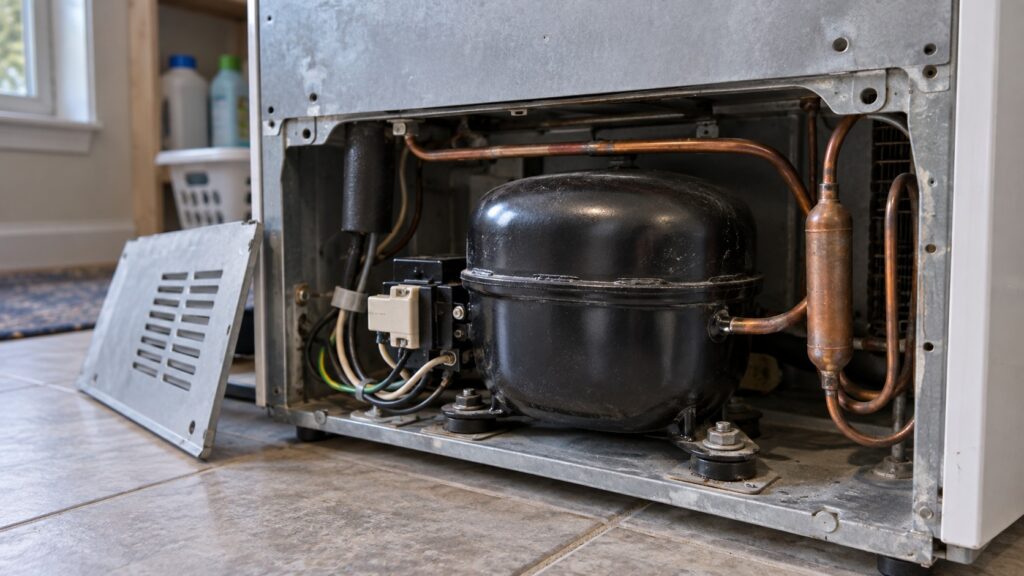
A compressor that has mechanically failed, a sealed system that has lost its charge through a leak, or windings that have burned out all call for opening the sealed system. That is a specialized repair involving evacuation, a new compressor, a new drier and a recharge, and it takes longer and costs much more than a relay or fan. On an older, basic cabinet, that repair often costs a large share of a new appliance, and a new unit also brings a warranty and better efficiency. On a newer or premium unit, such as a built-in column or a wine cabinet, the same repair can still make sense because the replacement itself is expensive and may need cabinet work.
The age of the unit matters more than the brand. A refrigerator in its first several years with a failed compressor is a strong candidate for repair, and one near fifteen years with a failing compressor is usually a candidate for replacement. Check your warranty status, because a sealed-system failure within the coverage period may change the picture entirely.
How do you weigh the decision?
- Get a diagnosis first, so you know whether the compressor or something around it failed.
- Ask what else is likely to fail soon. An older cabinet with a worn door seal and a weak fan may need more than one repair.
- Compare the repair to the cost of a comparable new unit, including delivery, installation and any cabinet changes.
- Consider how long you plan to stay. A short horizon favors the cheaper path.
Our Liebherr fridge repair or replace guide and the general refrigerator guide go through the rest of the checklist, including the sometimes-quoted rule of thumb that a repair costing half of a new unit favors replacement.
What should you do while you decide?
Move perishable food to a working refrigerator or a cooler if the cabinet is warming. Keep the door closed as much as possible, and unplug the unit if it smells of burning or if the compressor area is very hot. A compressor that is cycling on and off rapidly can damage itself, and turning the unit off for a few hours is safer than letting it struggle. Do not open panels or touch the sealed-system tubing yourself, since the refrigerant lines and the electrical parts are hazardous. When you are ready, you can read about our refrigerator repair service.
Does the warranty or a service plan change the answer?
It can. Check the purchase paperwork and any extended coverage before you pay for a sealed-system repair, because coverage for the compressor is sometimes longer than coverage for the rest of the appliance. Keep the model number and serial number from the rating plate handy, since they help a technician identify the right parts and help you answer questions about coverage. If coverage has ended, the age and value discussion above is the guide.