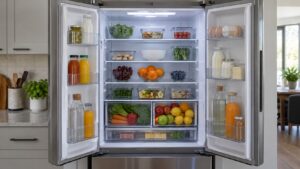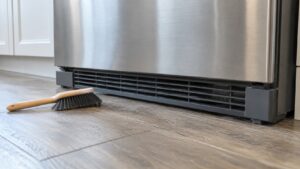
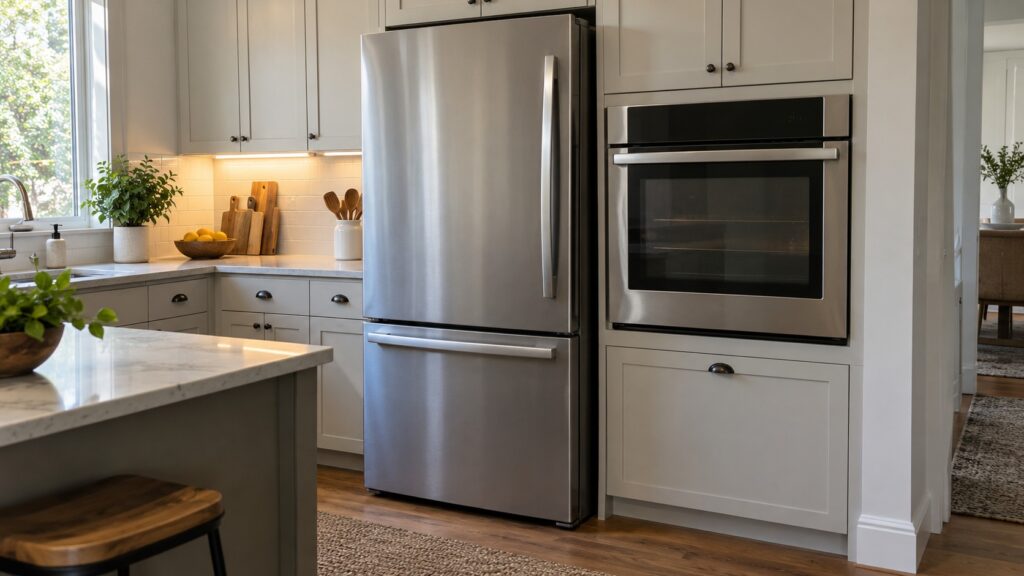
Liebherr fridge placement near oven runs and other heat sources comes down to one rule: keep the refrigerator away from anything that warms the air around it. An oven, a dishwasher, a radiator and direct sun all make the room hotter at the spot where the fridge must shed its own heat, so the compressor runs longer and the cabinet may struggle to stay cold. If the layout forces them side by side, follow the clearances in the manual and add the insulation gap it asks for.
Why does heat near a refrigerator matter?
A refrigerator is a heat pump. It moves heat from the cabinet into the room, and it can only do that as well as the room lets it. Put it next to a hot appliance and the air around its condenser is warmer than it should be, so the heat leaves more slowly. The compressor runs for longer to do the same job, the electricity bill rises and the parts wear sooner. Our installation and clearances guide lists the placement rule in a single line: away from ovens, dishwashers, radiators and direct sun.
The effect is also on the cabinet itself. A side wall that is heated by a neighboring oven transfers warmth into the cabinet, so the inside is harder to keep steady. That shows up as a compressor that never seems to stop, and it is often diagnosed as a fault when it is a placement problem.
What if the refrigerator has to go next to an oven?
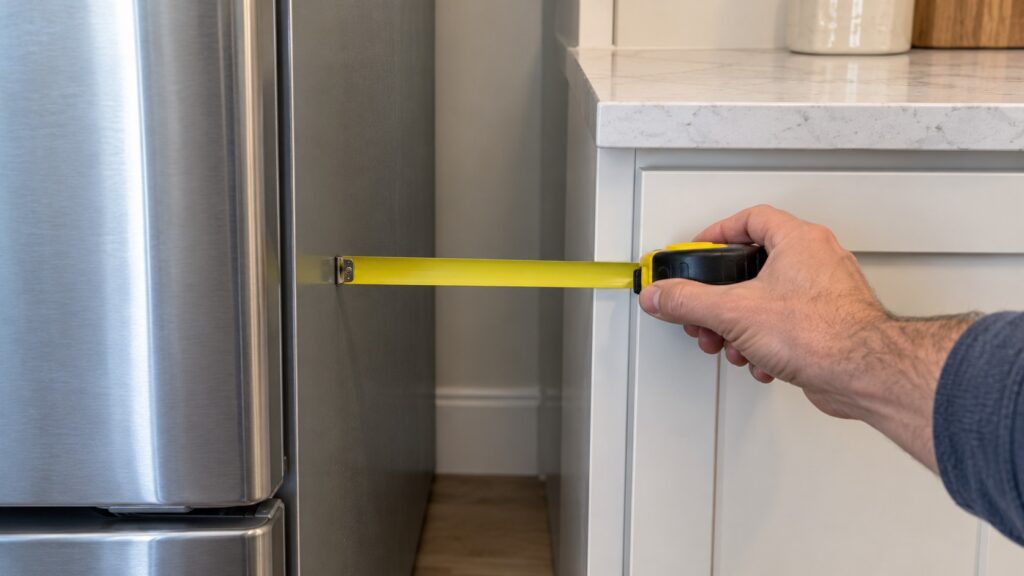
Sometimes the layout leaves no choice, especially in a small kitchen or a run of built-in appliances. In that case, follow the manual for both appliances. Each states the clearance it needs on the sides, and some manuals ask for a gap or an insulating panel between a refrigerator and a heat source. We do not state distances here because they differ by model, and the figures in the manual are the ones the design was tested with. Plan the gap before the cabinetry is built, not after.
If you can, put a tall cabinet, a pantry unit or a section of countertop between the two. A solid divider can help more than a small gap. Check where the oven vents its heat as well: some appliances release hot air at the front or the top, and a refrigerator above or beside that exhaust path is in the wrong place.
What about dishwashers, windows and radiators?
A dishwasher releases heat and steam during its cycle, so a refrigerator against one shares that warmth. A radiator or a heating vent behind or beside the cabinet warms its side or back. A sunny window warms the door and the top. None of these is a fault, but all of them make the refrigerator work harder. If you cannot move them, a screen, a blind or a shifted refrigerator position can reduce the effect, and clearances must still allow air to pass.
The same applies in a garage or utility room. A cabinet designed for a warm kitchen can behave oddly in a room that is very hot or very cold. The rating plate and the manual tell you the room range your model covers, and the appliance’s climate class should include the room where it will stand.
How do ventilation clearances fit in?
Every refrigerator pushes heat out of a coil at the back or underneath, and that heat has to leave. The manual specifies a gap behind, a gap above and a ventilation path. An appliance boxed into a tight alcove recirculates its own warm air and works harder for the same result. That shows up as a noisy, always-running appliance and a bigger power bill, and it is diagnosed as a fault more often than it should be. For built-in units, our Monolith column installation guide and our guide to combining Monolith columns describe the niche requirements. Where two columns sit side by side, the heat from one can reach the other, so plan the run with that in mind.
How can you tell the placement is the problem?
Signs include a compressor that runs for most of the day, a cabinet that runs warmer in the afternoon when the oven is in use or the sun is on the door, a side wall that feels warm to the touch and a cabinet that works better in cooler months. Compare how it behaves when the neighboring appliance is off. If the difference is clear, the placement is at least part of the cause. Our Liebherr fridge not cooling guide lists the other checks, such as the seal, the level and clear vents, which are worth ruling out too.
What can you change without rebuilding the kitchen?
Often quite a lot. Move the refrigerator if it is freestanding, keep the sun off the door, and make sure the clearances at the back and the top are free. If the refrigerator is built in, check that no panel or trim has closed off a ventilation path since installation. For a built-in or integrated installation that is wrong from the start, ask an installer or our team to look at the niche; our refrigerator repair page explains how a visit works. Do not cut into cabinetry or remove panels yourself.