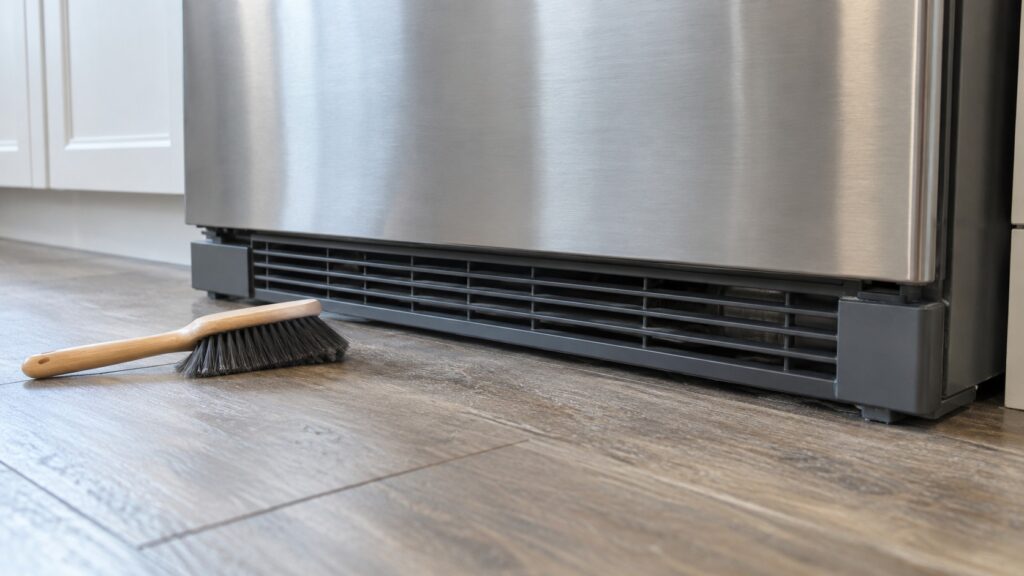
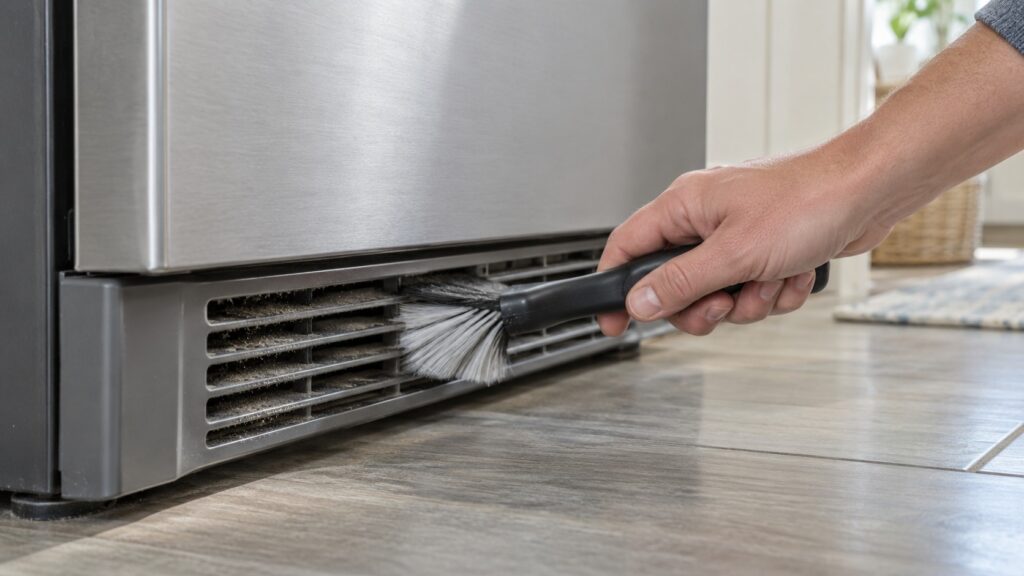
To clean Liebherr fridge ventilation grille areas, use a vacuum with a soft brush attachment on the grille and any open slots, and a dry, soft brush for what the vacuum misses. Do the work from the outside only: never remove panels, never spray liquid at the grille and never reach into the compressor area. Dust on the heat-releasing parts is one of the biggest causes of poor efficiency and avoidable wear, and a clean grille lets the heat leave.
What does the ventilation grille do?
Every refrigerator moves heat from the inside of the cabinet to the outside. The heat leaves through a condenser, a coil or plate at the back or underneath, and air must flow over it to carry the heat away. The grille is the opening that lets that air in and out. If the grille and the surfaces behind it fill with dust, the air flows less freely, the heat stays in, and the compressor runs longer to do the same job. Our annual maintenance checklist puts it plainly: dust on the condenser is the single biggest cause of poor efficiency and avoidable wear.
The result is not dramatic at first. A cabinet with a dusty condenser keeps working but runs longer, uses more power and may be a little noisier. Over the years, that extra work shortens the life of parts. This is why a quick look at the grille at the start of each season is cheap insurance.
Where is the grille on your model?
It depends on the design. Many freestanding refrigerators have a grille at the bottom front, under the door, which is often a plastic strip that clips on and off. Some have a coil or grille at the rear. Built-in and column units can be vented differently, and our guides to Monolith column installation and to the installation clearances describe how a niche must leave air a way in and out. The owner’s manual for your model shows where the grille is and whether it is meant to be removed by the owner. If the manual does not say, treat it as fixed and clean only what you can reach without taking anything apart.
How do you clean it safely?
- Check the manual for where the grille is and whether it unclips. If it is an owner-removable strip, remove it as shown.
- If the manual allows it, switch the appliance off with its own control before working close to the grille. If you are unsure, work only with the vacuum on the outside of the grille.
- Use a vacuum with a soft brush attachment on the grille and any slots, moving along the slots rather than pushing the brush in.
- Use a dry, soft brush to loosen dust that clings, and vacuum it as it comes free.
- Wipe the grille itself with a barely damp cloth if it is greasy, and dry it. Do not spray cleaner at it.
- Refit the grille if you removed it, switch the appliance back on if you switched it off and check that it starts cooling.
Do not push anything stiff into the slots, such as a wire hanger, because the fins and the lines behind them are delicate. Do not remove the rear or lower access panels to reach deeper; that is a technician’s job, and the area holds parts that can be damaged.
How often should you clean it?
Once a year is the baseline in our maintenance checklist, or twice if your kitchen is dusty. Pets, a dusty house, a refrigerator placed near an open door and a kitchen where people cook with a lot of oil all make dust build up faster. If the appliance sits in a built-in niche, look at the vent areas as well. Make a note of the date so you do not have to remember. If you notice that the compressor runs longer than it used to or the cabinet is working to stay cold in summer, check the grille before suspecting a fault.
What if cleaning does not help?
If the grille is clean and the cabinet still runs long or struggles, look at the other causes on the list. Check the door seal and the level, and make sure the vents inside are not blocked by food; our PowerCooling explanation shows why clear inside vents matter. Make sure the clearances around the appliance are as the manual says, since a tight alcove recirculates its own heat. Our Liebherr fridge not cooling guide lists the next checks.
A noisy appliance can also be a sign of a dirty fan area, but do not open anything to find out. See our strange noises guide for what the sounds mean and what a technician looks at.
When should you call a technician?
Call if the compressor area is clogged beyond what you can reach, if you see damage to the grille or fins, if you smell burning, or if the cabinet will not stay cold after cleaning. If you smell burning, switch off the breaker at the panel while standing on a dry floor. Our refrigerator repair page explains how a visit works.
It also helps to look at the surroundings. Keep the space around the appliance clear of boxes and bags, because anything that blocks the air path undoes the work of cleaning. Dust that builds quickly may point to a rug, a pet bed or an open window nearby, and a small change to the room can save you cleaning time later.