
Liebherr interior features carry names that sound like marketing and describe real hardware: a drawer with a humidity slider, a shelf made to a specific pattern, a charcoal filter in the airflow path. Knowing which name belongs to which object is what turns “the salad drawer is wet” into a setting you can change, and “the fridge smells” into a filter you can replace. This glossary covers the parts you can see and touch inside the cabinet.
The two drawers, and why the difference matters
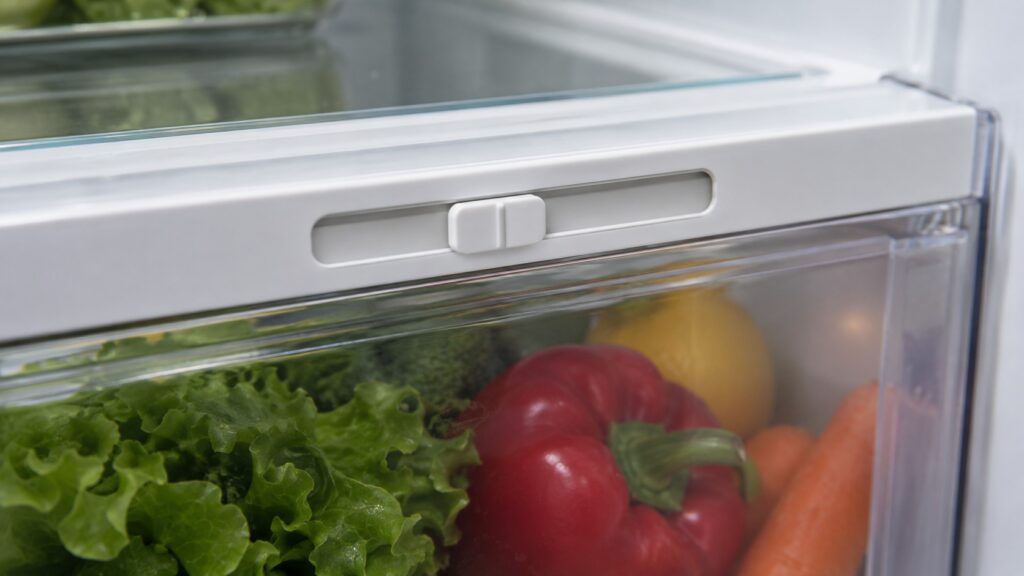
Produce and proteins want opposite conditions. Leafy vegetables lose water to dry air and wilt; meat and fish sitting in damp air spoil faster and develop surface moisture. The high-humidity drawer holds moisture in, the low-humidity drawer lets it out, and each has a slider that sets how much.
Two practical consequences follow. First, a drawer with water pooling in the bottom is usually the high-humidity drawer doing exactly its job with the slider set high and too much wet produce inside — adjust the slider before reporting a leak. Second, putting meat in the high-humidity drawer and salad in the low-humidity one produces precisely the complaints owners blame on the appliance.
Shelves and how they behave
The glass shelves are safety glass on molded supports, designed to lift out and reposition without tools. They are also, like all glass, unhappy with sudden temperature change: a shelf taken out of a cold cabinet and rinsed under hot water can crack, and that is the most common way a good shelf is lost.
Wash them in the sink with warm water after letting them come to room temperature, and order a replacement by the exact model when one is broken, because dimensions and trim differ between lines. Our guide on refrigerator shelves covers adjustment and replacement in detail.
Air, filters and smell
The charcoal filter sits in the air path — usually on a wall or ceiling mount inside the cabinet — and it absorbs the odors that circulating air would otherwise spread from one shelf to another. It is a consumable. Once it is saturated it does nothing at all, and nothing about the appliance announces that.
Replace it on the schedule in the manual, and treat a fridge that has started smelling of its contents as a filter question first and a cleaning question second. In a wine cabinet the same filter matters even more, because wine takes up odors through the cork over time — the routine is in our guide on the wine cabinet charcoal filter.
Door bins and racks deserve a mention alongside the shelves, because they are the parts that get broken. A bin loaded with full bottles is carrying more weight than it looks, and a door slammed on an overloaded bin cracks the bin rather than the door. Distribute weight low and near the hinge side, and treat a cracked bin as a part to order rather than something to tape — a fragment that falls behind a drawer runner can stop the drawer closing, and a drawer that does not close is a temperature problem.
The ice maker, where one is fitted, is the other interior component that owners interact with. It has a water supply, a fill valve and a mold, and it is the part most affected by water quality — which is why the filter schedule matters to the ice long before it matters to the drinking water.
Finishes, and what they ask of you
Finish names appear in model descriptions and get mistaken for capability. They are not: two cabinets in different finishes can be mechanically identical, and the choice affects cleaning, not cooling.
Names that describe cooling, not interiors
Some of the best-known names on these appliances describe systems rather than parts you can hold. Separate circuits for the fridge and freezer sections, fan-assisted circulation, automatic defrost, rapid-chill and rapid-freeze boosts — each has its own name on the spec sheet and its own guide, because each behaves differently when it fails. Our explanations of the fresh-food compartment and fan-assisted cooling cover the two that come up most.
Knowing which family a name belongs to saves a wasted conversation. A drawer, a shelf or a filter is something you can inspect this evening; a cooling system is something a technician measures.
How to use the words when something is wrong
“The high-humidity drawer has water standing in it” describes a setting. “The charcoal filter has not been changed since we bought it and the fridge smells” describes a consumable. “One shelf of the fridge is warmer than the rest” describes airflow, and a technician will arrive thinking about fans and vents rather than about drawers.
All three are more useful than “the refrigerator is not right,” and all three take the same ten seconds to say.
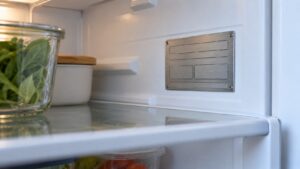
A closing note on where these names are useful: when you order a part. A drawer, a shelf, a filter and a bin all look generic in a photograph and are not interchangeable between lines or sizes. Quote the model and serial from the plate inside the cabinet, say which compartment the part lives in, and describe it by the name the manual uses. That combination gets the right part the first time far more reliably than a picture ever will.
When to call
Call when a compartment will not hold temperature, when frost keeps returning, when a fan has become noisy, when water collects outside a drawer, or when a door no longer seals against its gasket. Those are appliance faults rather than settings, and the routine that keeps them rare is in our guide on annual maintenance.
We are an independent repair company and not a factory service arm. Pricing starts from a diagnostic visit, and we confirm the estimate before any work begins. Liebherr refrigerator repair covers fans, sensors, defrost systems, door hardware and controls, and you can schedule a visit online.